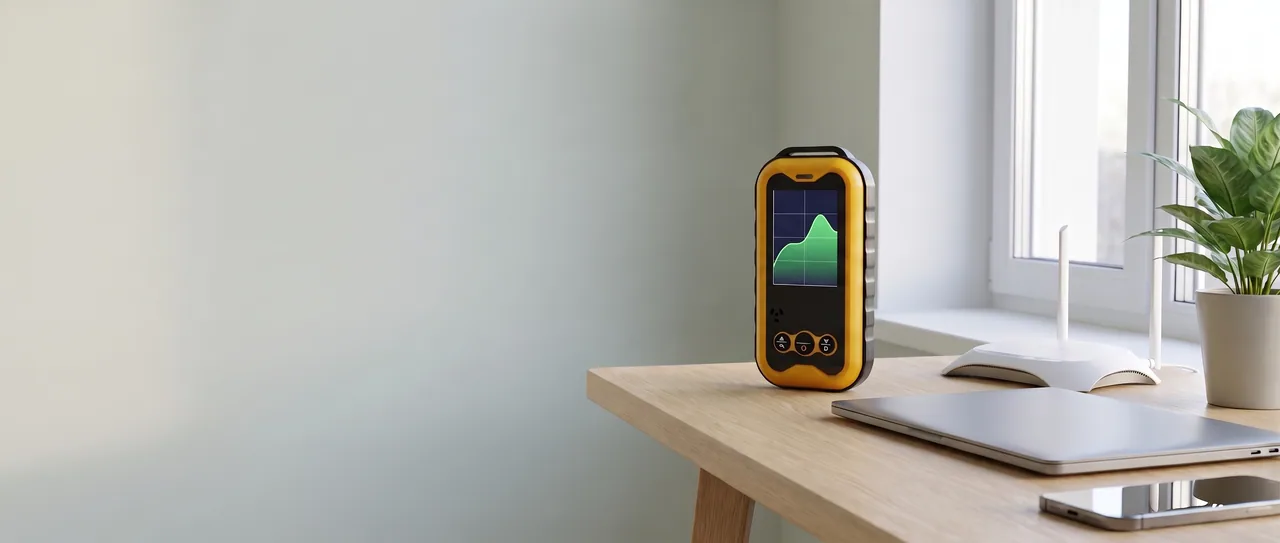
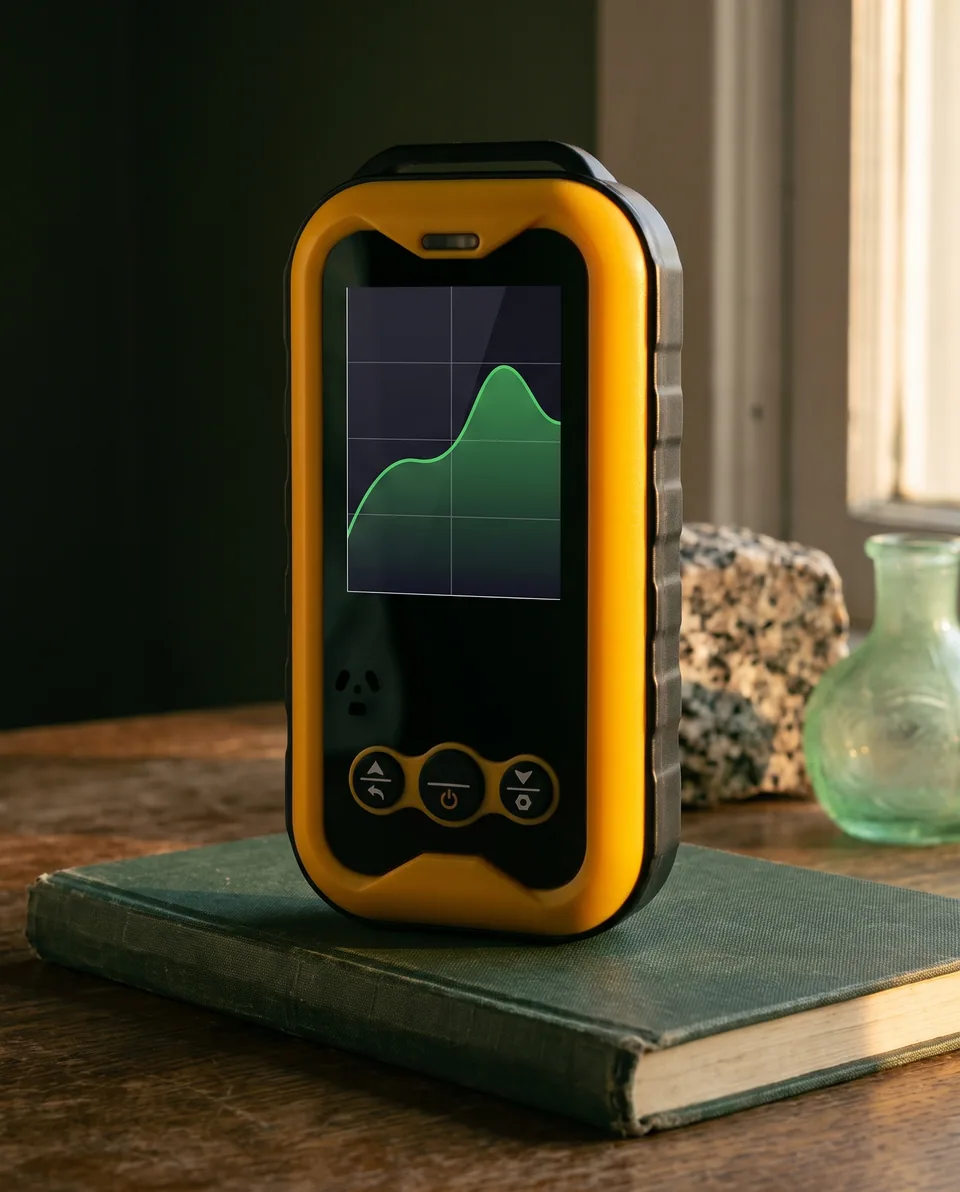
The yellow Geiger counter standing on a dark green field notebook on an oak table by a window at dusk, with granite and a pale green glass vase blurred behind

Pocket Geiger counter

Geiger Counter Shop the Geiger counter delivered in the UK

A compact Geiger counter with a glass Geiger-Muller tube. It shows the dose rate in µSv/h, the count rate in CPM and a trend graph, for the curious, collectors of old glass and minerals, and travellers.

  • Glass GM tube · beta, gamma, X
  • 2.4-inch colour screen
  • 1,800 mAh · USB-C

Try it here

Why the reading jumps, then settles

Radioactive decay is random, so counts arrive at irregular moments. The instant reading jumps about while the running average slowly settles. Try it below: this is an illustration of random counts, not a measurement.

Last 10 seconds 18CPM
Running average 20.2CPM
Time elapsed 05:00
Total counts 101
Chart of simulated counts: each bar is the number of counts in 10 seconds, and the line is the running average.

In one independent test, a J321-type tube counted about 20 CPM from natural background.

Time runs ten times faster than real time here.

This is a simulation of random counts, not a measurement and not this counter's reading. The real device shows its own instant and average readings, plus a dose rate trend graph on its screen.

Before comparing two places or two objects, let the counter run for a few minutes and read the average, not the instant figure.

Close-up of the Geiger counter's lit colour screen above green graph paper
2.4-inch screen

On the screen

What the screen shows

The 2.4-inch colour screen shows the dose rate in µSv/h, both in real time and as an average, the count rate in CPM or CPS, and the cumulative dose in µSv. A trend graph follows the dose rate over time. You set two alarm thresholds, one for dose rate and one for dose, with sound, flashing light or vibration. Data is kept after switching off, and the manufacturer describes a download to a PC over USB-C. Readings are indicative.

  • Dose rate, live and averageThe real-time dose rate in µSv/h sits next to an average that smooths out the random jumps.
  • Counts per minuteThe raw count from the tube in CPM or CPS, the figure to read near beta sources.
  • Alarms you setTwo alarms, dose rate and dose, with thresholds you choose and sound, flashing light or vibration.
A desk by a window with a laptop, a Wi-Fi router, a phone face down and a plant, the yellow Geiger counter on the right

Honest limits

What it does not measure

This is a consumer radiation detector for general information only. Its readings are indicative: it is not a calibrated measuring instrument, not personal protective equipment and not a radon test. If you see an unusually high or persistent reading, move away from the source, do not handle the object and contact the UK Health Security Agency (UKHSA) or your local authority. In an emergency, call 999.

  • No alphaAlpha particles cannot get through the glass wall of the tube, so alpha does not register.
  • Not a radon testRadon in a home is measured with a dedicated radon test kit; the radon guide explains how.
  • Not EMF or 5GWi-Fi, mobile phone and power line fields are not ionising radiation, so the counter ignores them.
  • Not a food testA handheld counter cannot tell you whether food or water is contaminated, so never use it for that.
Everyday curiosity

What people check with it

It is a tool for everyday curiosity: watch the natural background at home, compare old objects and rocks against it, and see how the reading changes on a flight. The average tells the story.

A shelf of yellow-green uranium glass with the yellow Geiger counter in front

Uranium glass and old objects

Collectors hold the counter near vintage uranium glass, which glows green under UV light, or near an old radium-dial clock, then compare the count with background. Look, but do not take anything apart: keep objects intact, never open a radium dial, never serve food or drink in them, and wash your hands after handling. A broken piece? Ask your local authority.

Rocks and minerals in trays seen from above, with a magnifying glass

Rocks and minerals

Granite and some minerals can read above background, and the figure varies from one stone to the next. Radiation drops quickly with distance, so hold the counter in the same spot each time and compare averages rather than peaks. Keep samples in their box, and treat the reading as a comparison, not a precise measurement.

An aeroplane tray table with a coffee cup and a window on clouds

On a flight

At cruising altitude the dose rate reads higher than on the ground, because cosmic radiation increases with height, as the US EPA explains. A transatlantic flight adds about 0.08 mSv according to the UKHSA. The counter is a small device with a built-in lithium battery, so check your airline's rules for batteries in the cabin.

Getting started

Ready in four steps

Charge the counter with the USB-C cable in the box; no mains charger is included. Switch it on and let it count the background for a few minutes. Pick the main screen, numbers or the trend graph, then set the two alarm thresholds and choose sound, flashing light or vibration. The menu offers several languages. The manufacturer describes a data download to a PC over USB-C with its own software, which the shop does not supply.

A desk with the yellow Geiger counter charging over USB-C next to an open laptop
  1. Charge over USB-CPlug the supplied USB-C cable into a 5 V USB port and let the battery charge.
  2. Switch onTurn it on and let it count the natural background for a few minutes.
  3. Choose the screenPick the main display: large numbers or the dose rate trend graph over time.
  4. Set the alarmsSet the dose rate and dose thresholds, then choose sound, flashing light or vibration.

Know the difference

Geiger counter or another kind of detector?

Not every device sold for "radiation" actually counts it. Here the Geiger counter sits next to a cheap 3-in-1 gadget, which mostly reads electromagnetic fields, and next to a scintillation counter, compared by category, never by brand.

SpecificationGeiger Counter Shop3-in-1 EMF 'radiation' gadgetScintillation counter
What it detectsIonising radiation: beta, gamma and X-raysMostly electromagnetic fieldsGamma and X-rays, with more sensitivity
SensorGlass Geiger-Muller tubeMostly an EMF sensor, varies by deviceScintillation crystal and light sensor
Units shownµSv/h, µSv, CPM and CPSMostly field readings, varies by deviceVaries by device
Sensitivity at backgroundAbout 20 CPM with a J321-type tube (one independent test)No ionising count, or very lowHigher: more counts at the same background
Energy informationNo spectrumNoneOften a spectrum
Typical public price (Sept 2026)About £37 to £81 for consumer Geiger countersAbout £13 to £28About $250 to $600 (US listings)
Who it suitsCurious owners, collectors and travellersChecking electrical fields, not radiationHobbyists who want gamma detail and a spectrum

Sources: the manufacturer's spec sheet for this counter, one independent test, and public listings by category read on 28 September 2026. Prices are rough orders of magnitude, not offers, and no brand is named.

Flat lay of the yellow Geiger counter, a coiled USB-C cable, a small booklet and two plain cards

What you get

What's in the box

Included in the box

  • The counter with its built-in rechargeable battery
  • A USB-C cable
  • The user manual
  • The manufacturer's inspection slip and warranty card

FAQ

Geiger Counter Shop: your questions

How much does a Geiger counter cost?

Public UK listings for consumer Geiger counters ran from about £37 to £81 when we looked on 28 September 2026, a rough order of magnitude rather than an offer. Scintillation counters with a spectrum sit much higher, about $250 to $600 on US listings. Cheap 3-in-1 'radiation' gadgets, at about £13 to £28, mostly read electromagnetic fields rather than ionising radiation. The price of this counter, with VAT and delivery included, is shown on the page.

What can a Geiger counter detect, and what can't it?

Its glass Geiger-Muller tube counts beta particles, gamma rays and X-rays. Alpha particles do not get through the glass, so alpha does not register. It does not measure a radon concentration (use a radon test kit), it does not react to EMF, Wi-Fi or 5G, which are not ionising radiation, and it cannot tell you whether food or water is contaminated.

What is normal background radiation?

Background radiation is everywhere, so the counter always counts something. The UKHSA puts average UK exposure at about 2.6 mSv a year, quoted here for context only. In one independent test, a tube of this type counted about 20 CPM at background; the US EPA notes that background varies by place and rises with altitude. If a reading is unusually high or persistent, move away, do not handle the object and contact the UKHSA or your local authority (999 in an emergency).

How is radiation measured on a Geiger counter?

The tube turns each particle it detects into a count, shown as CPM or CPS. The µSv/h figure is a dose rate the counter works out from those counts. Near a beta source it runs high, because the tube has no beta shield, so read the CPM instead. CPM depends on the tube, so never compare CPM between two different counters; compare readings taken with the same counter.

Can I take a Geiger counter on a plane?

It is a small device with a built-in battery of about 6.7 Wh. For reference, the US FAA limits lithium-ion batteries in personal devices to 100 Wh, but rules vary, so check your airline's rules before you fly. In the air, expect the reading to climb at cruising altitude because of cosmic radiation: according to the UKHSA, a transatlantic flight adds about 0.08 mSv.

How long does the battery last, and how do I charge it?

The manufacturer states 30 days or more in long-life mode, while an independent test found about 5 days in normal use, so the mode you choose makes a real difference. Charge it with the USB-C cable in the box; no mains charger is included. The 1,800 mAh battery is built in and cannot be replaced by the user.

Is a dosimeter the same as a Geiger counter?

Not quite. This counter has a cumulative dose mode that is handy for tracking, but it is not a regulatory dosimeter. The manufacturer gives a range of 0.01 µSv/h to 50 mSv/h and a relative error under 10% at 1 mSv/h on its own reference. It is a consumer counter with indicative readings: not a calibrated instrument, and it comes with no calibration certificate.

Where do I get a Geiger counter in the UK?

Right here: UK orders ship free from a warehouse in the United Kingdom, so there is no customs step. Orders are prepared in 1 to 2 working days, then delivered in 2 to 5 working days (indicative, not a guaranteed date), with tracking by email. Payment goes through Stripe. You have 30 days after delivery to change your mind, on top of your 14-day cancellation right and the Consumer Rights Act 2015. No licence is needed, as the counter contains no radioactive source.

Guides

Geiger Counter Shop guides

Plain-English guides to reading a Geiger counter, background radiation and old objects, written from official sources.

See all guides
The yellow Geiger counter on a bookshelf under a warm brass lamp in the evening

Your own window on background radiation

A Geiger counter you can carry, with a glass GM tube, a clear colour screen and alarms you set yourself. Watch the background at home, check old glass, or follow the figures on your next flight.

Buy a Geiger counter · £79.00

Free delivery from UK stock, and 30 days after delivery to change your mind.

Your basket