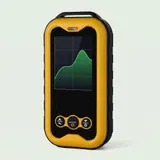

Start with the tube, and ask which one is fitted
The Geiger-Muller tube is the part that actually counts radiation. As HyperPhysics at Georgia State University explains, it is a wire inside a gas-filled cylinder held at high voltage: a particle that ionises a few gas molecules sets off an avalanche of electrons, and the counter turns each pulse into a click and a count. At this price, look for a glass tube of the J321 size class. The maintainer of an open-source Geiger counter firmware describes short tubes of the J614 type as less sensitive at background than a J321.
The listing should name the tube. If it does not, ask the seller which tube is fitted before you pay. One independent test of a budget counter recommends checking this, because some batches were shipped with a different tube from the one advertised. A less sensitive tube collects fewer counts at background, so its readings take longer to settle and a small change is harder to spot.
Know what it detects, and what it does not
A glass-tube counter detects gamma rays, X-rays and higher-energy beta particles. Alpha particles cannot get through the glass wall; only tubes with a thin mica window can see them, and a glass tube has none. So a counter in this bracket reacts to uranium glass, older uranium glazes, granite or a radium dial through their beta and gamma, never through alpha. If you own such objects, the US EPA advises keeping them intact, never taking a radium dial apart and not serving food or drink in them. Wash your hands after handling them, and if one breaks, ask your local authority how to dispose of it.
It is just as useful to know what no Geiger counter under £100 does. It does not measure radon: in the UK, radon is measured with a radon measurement pack, and the UKHSA's UK Radon website (ukradon.org) maps the radon Affected Areas where testing is worthwhile. It does not test food or water, it cannot pick up EMF, Wi-Fi or 5G, and it cannot tell you that an object or a room is harmless. Its readings are indicative.
| Criterion | What to look for | Why it matters |
|---|---|---|
| Tube | A glass GM tube named in the listing, J321 size class | Short J614-type tubes are described as less sensitive at background |
| Radiation types | Beta, gamma and X-rays stated; no alpha claim on a glass tube | Alpha needs a thin mica window, which glass tubes lack |
| Readings | µSv/h and CPM, an average reading and a trend graph | CPM is the raw count; µSv/h runs high on beta sources |
| Alarms | Adjustable dose rate and dose alarms by sound, light or vibration | You are alerted without watching the screen |
| Power | Built-in USB-C battery or AA cells, with battery life given both ways | Long-life mode claims can sit far above normal use |
| Claims | No protection promise, no calibration claim without a certificate, no 3-in-1 EMF gadget | These point to a gadget or to marketing, not to a better counter |
Screen and readings: µSv/h, CPM, average and trend
A good budget counter shows two kinds of figure. Dose rate, in µSv/h, is an estimate of exposure per hour. Count rate, in counts per minute (CPM), is the raw number of pulses from the tube. You want both. On beta sources, a counter without a beta shield reads high in µSv/h, and an independent test recommends reading CPM there instead. CPM depends on the tube, so it cannot be compared between two different counters. An average reading and a dose-rate trend graph help, because readings take time to settle near a source and to fall back to background afterwards.
For context, the UK Health Security Agency (UKHSA) puts the average exposure in the UK at about 2.6 mSv a year, around 1.3 mSv of it from radon, and a transatlantic flight at 0.08 mSv. Background also varies from place to place. These figures are context, not a threshold for your own readings. If a reading is unusually high or stays high, move away, do not handle the object, and contact the UKHSA or your local authority. In an emergency, call 999.
Alarms and cumulative dose
Alarms let the counter keep watch while it sits on a desk or travels in a bag. Look for thresholds you set yourself rather than one fixed level, and for more than one way to alert you: sound in a quiet room, vibration or a flashing light where a beep would disturb people. Two separate alarms, one for dose rate and one for accumulated dose, cover both a sudden rise and a slow build over a long day. Check, too, that your settings are kept when the counter is switched off.
Cumulative dose mode adds up the estimated dose over time, and a timed dose lets you log a set period, such as a trip. Treat both as indicative figures from a consumer device, not as a regulatory dosimeter record. A counter that keeps cumulative dose, curves and alarm history after it powers off saves you from starting again when the battery runs flat.
Battery and charging: built-in USB-C or AA cells
Budget counters run either on AA cells or on a built-in lithium-ion battery. AA models are easy to power anywhere, but you keep buying and swapping cells. A built-in battery charges over USB-C with the same kind of cable as a phone, but it is usually not user-replaceable, and the box may contain a cable and no mains charger. For flights, US aviation rules (FAA) limit lithium-ion batteries in personal devices to 100 Wh. A 1,800 mAh cell at 3.7 V is about 6.7 Wh, but always check your airline's rules.
Treat battery life claims with care. A long-life mode figure is not the same as everyday use. For one counter in this bracket, the manufacturer claims 30 days or more in long-life mode, while an independent test puts it at about 5 days in normal use. Ask for both figures, and plan around the lower one.
Traps to avoid in this price bracket
The cheapest "radiation detectors", at about £13 to £28, are often 3-in-1 gadgets that are mostly electromagnetic field (EMF) meters, not Geiger counters. If there is no Geiger-Muller tube and no CPM reading, the device is not counting ionising radiation. The next trap is the promise: no consumer counter offers protection, and no reading can declare a room or an object harmless. A listing that calls a budget counter a calibrated instrument, or sells it for professional work, should show a dated calibration certificate. Without one, it is marketing.
Be wary of struck-through "was" prices and ticking timers too. In September 2026, consumer Geiger counters listed in the UK cost about £37 to £81. Beyond that, consumer scintillation counters with a spectrometer sit in a clearly higher price bracket and are more sensitive to gamma than a Geiger tube of this size. That is an honest step up, not a requirement.
Frequently asked questions
Are cheap Geiger counters any good?
For curiosity, hobby use and travel, a counter under £100 can be useful if it has a real glass Geiger-Muller tube, shows CPM as well as µSv/h, and is honest about its limits. It gives indicative readings of beta, gamma and X-rays, not a laboratory measurement. What is not good is an EMF gadget at £13 to £28 sold as a radiation detector.
What is the best Geiger counter under £100?
There is no single winner, so rank the criteria instead: a named glass tube of the J321 size class, beta, gamma and X-ray detection, µSv/h and CPM with a trend graph, adjustable alarms and an honest battery claim. Geiger Counter Shop sells one counter built that way: a glass GM tube (J321 type as listed by the supplier), a 2.4-inch colour screen, two alarms and a 1,800 mAh USB-C battery, sent free from UK stock: prepared in 1 to 2 working days, then delivered in 2 to 5 working days (indicative).
Does a Geiger counter need calibration?
Consumer counters are set at the factory by the manufacturer, and that factory setting is not a calibration certificate. A counter should only be described as a calibrated instrument when it comes with a dated certificate from a calibration laboratory. Without one, treat its readings as indicative, compare them over time on the same counter, and watch the trend rather than a single figure.
Sources
Our guides are based on the supplier's listings and public documentation. We have not tested the counter ourselves.


