
The short answer: rocks and soils hold traces of uranium and thorium
Radioactivity in rocks is ordinary rather than exotic. The Society for Radiological Protection (SRP), a UK professional body, notes in its article "Our Radioactive Home" that traces of uranium and thorium are found in rocks and soils across the United Kingdom, in some places at levels that make a Geiger counter click; its example is a pebble brought back from Cornwall. The US Environmental Protection Agency (EPA) makes the same general point: natural background radiation comes mostly from minerals in the ground, from water and from cosmic radiation, it varies from place to place and it rises with altitude. So a counter held over a rock is always reading two things at once: the rock itself, and the background around it.
That is why a single number means little on its own. A rock becomes interesting only when it reads clearly above the background of the room you are in, measured in the same way. For context, the UK Health Security Agency (UKHSA) puts the average exposure in the UK at about 2.6 mSv a year. That figure is a national average, not a threshold, and it says nothing about any particular stone on your table.
The minerals collectors ask about
A handful of uranium minerals come up again and again among rock and mineral collectors. They are described here as minerals, not as items to buy, following the Wikipedia entry for each. Autunite is a yellow-green calcium uranyl phosphate, radioactive, that glows bright green under ultraviolet light; it has been used as a uranium ore. Uraninite, also known as pitchblende, is a mineral and ore rich in uranium. Torbernite is a green copper uranyl phosphate, radioactive, found in granites. Carnotite is a potassium uranium vanadate, an important uranium ore described as slightly radioactive.
If you are wondering what uranium ore looks like, the honest answer is that it depends on the mineral. The yellow-green of autunite and the green of torbernite are the colours mentioned most often, and the UV glow of autunite is its best-known trait. None of this ranks the minerals. Which rock is the most radioactive is not something a pocket counter can settle, because its readings depend on the individual sample, the distance and the tube.
| Mineral or rock | What it is | What to expect on a glass-tube counter |
|---|---|---|
| Autunite | Yellow-green calcium uranyl phosphate, radioactive, glows bright green under UV | Varies by sample: compare average CPM with your background |
| Uraninite (pitchblende) | Mineral and ore rich in uranium | Varies: a count above background, never the uranium content |
| Torbernite | Green copper uranyl phosphate, radioactive, found in granites | Varies: compare CPM at the same distance as your other samples |
| Carnotite | Potassium uranium vanadate, an important uranium ore described as slightly radioactive | Varies: wait for the average before comparing |
| Granite | Can hold traces of natural radioactive elements (EPA) | A little beta and gamma that varies from stone to stone; falls off quickly with distance |
| Ordinary rocks and soils | Hold traces of uranium and thorium (SRP) | In some places enough to make a counter click; always read against background |
Granite and ordinary stones
Most rocks in a garden, on a drive or along a footpath are not uranium minerals, yet some still register. The EPA's page on granite countertops explains that granite can contain traces of natural radioactive elements that give off a little beta and gamma radiation, and that the amount varies from one stone to another. Two worktops that look alike can read differently, and so can two pebbles of the same colour picked up in different places. The SRP makes the same point about rocks and soils in general: local geology matters more than appearance.
The EPA adds two points worth keeping in mind. Radiation from a stone falls off quickly with distance, so a reading taken against the surface is not what reaches you across the room. And measuring a worktop precisely takes calibrated instruments and a trained user, which is beyond a pocket counter. The EPA also notes that radon from the ground is a far more common concern than granite, and a Geiger counter does not measure radon: in the UK, UKHSA points to a radon measurement pack (see ukradon.org). Our granite guide goes further on worktops.
How to check a rock with a pocket counter
A careful routine turns a click into a useful comparison. Start with your background: switch the counter on away from your samples, let it settle and note the average CPM. One independent test of a counter with this type of glass tube found about 20 CPM at background, but CPM depend on the tube, so only compare readings taken with the same counter. If you have a UV lamp, use it first: a bright green glow can point to a fluorescent mineral such as autunite. Then hold the counter close to each sample, at the same distance every time, and wait for the average rather than reading the first number.
Compare CPM rather than µSv/h. A glass tube without a beta shield overstates the dose rate in µSv/h when a sample gives off beta, according to the same independent test, so the count rate is the fairer figure for comparing stones. Readings also take time to settle on a sample and to fall back to background after a more active one, so leave a pause between samples. Keep simple notes for each piece: distance, average CPM and date.
What the counter cannot tell you
A Geiger counter counts pulses; it does not analyse a rock. HyperPhysics at Georgia State University describes the tube as a wire at the centre of a cylinder under high voltage, where a particle that ionises a few gas molecules triggers an avalanche of electrons and a pulse of current. Each pulse is one count, whatever caused it. So the counter cannot tell you which mineral you are holding, or how much uranium a sample contains. Alpha particles are out of reach too: a glass tube does not register them, and the EPA notes that alpha comes from heavy elements such as uranium, radium and polonium.
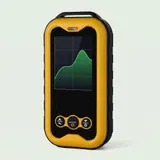
Readings are indicative. A consumer counter is not a calibrated measuring instrument, not protective equipment and not a radon test, and it does not test food or water. The pocket counter this shop sells fits that description: a glass Geiger-Muller tube (J321 type as listed by the supplier) that detects beta, gamma and X-rays, a 2.4-inch colour screen showing µSv/h and CPM, a trend graph, adjustable alarms and a 1,800 mAh battery charged over USB-C, delivered free from UK stock for UK orders.
Keeping a small collection
A few samples in labelled trays are easier to follow than a loose pile. Give each piece a label with its name as sold or found, where it came from and the date, and keep your reading notes with it: background, distance and average CPM. Measuring the same sample in the same way from time to time shows whether your routine is consistent. On a counter with a trend graph, the curve also shows whether a reading has settled before you write it down, which makes your notes easier to compare later.
If a piece breaks or starts to crumble, do not improvise. For broken antiques, the EPA advises asking the local authority how to dispose of them, and the same step applies to a damaged sample: ask your local authority. If you measure an unusually high or persistent level, move away from the source, do not handle the object and contact the UK Health Security Agency (UKHSA) or your local authority. In an emergency, call 999.
Frequently asked questions
What type of rocks are radioactive?
To some degree, many of them: the SRP notes traces of uranium and thorium in rocks and soils across the UK, and the EPA says granite can hold traces of natural radioactive elements. The minerals collectors usually mean are those built around uranium, such as autunite, torbernite, carnotite and uraninite. A pocket counter cannot rank them or name the most radioactive rock.
How do you test if a rock is radioactive?
With a Geiger counter you can check whether it reads above background. First note the average count in the same room, then place the counter close to the rock, wait for the average and compare the two CPM figures. A count clearly above background suggests the rock gives off beta or gamma radiation the tube can see; it does not say how much radioactive material the rock holds.
How can you tell if a rock contains uranium?
Not with certainty at home. A bright green glow under UV plus a count above background is a clue, since autunite glows that way and is a uranium mineral, but it is never an identification. Other stones, granite among them, can also read above background, and a counter cannot name a mineral or measure how much uranium it contains.
Is uranium ore radioactive?
Yes. Uraninite, also known as pitchblende, is a mineral and ore rich in uranium, and Wikipedia describes autunite and torbernite as radioactive and carnotite, an important uranium ore, as slightly radioactive. How a given piece reads on a glass-tube counter varies with the sample and the distance, so compare its CPM with your background rather than trusting a single figure.
Sources
- Society for Radiological Protection (SRP), Our Radioactive Home
- U.S. EPA, Granite Countertops and Radiation
- Wikipedia, Autunite
- U.S. EPA, Radiation Basics
- U.S. EPA, Radioactivity in Antiques
Our guides are based on the supplier's listings and public documentation. We have not tested the counter ourselves.


