
The short answer: some things register, many do not
Radioactivity is part of any ordinary home. According to the US Environmental Protection Agency (EPA), natural background radiation comes mostly from minerals in the ground, from water and from cosmic radiation; it varies from place to place and rises with altitude. On top of that, a few objects carry natural or added radioactive material: old uranium glass and some uranium-glazed tableware, luminous radium dials, some stone, and anything rich in potassium. Only some of these make a pocket Geiger counter react above background, and usually only when the counter is held close to them.
The UK Health Security Agency (UKHSA) puts average exposure in the UK at about 2.6 mSv a year, against 6.2 mSv in the United States (a figure the EPA also gives, citing the NCRP). These are context, not thresholds that tell you anything about a specific object. A pocket counter gives indicative readings: it is not a calibrated measuring instrument, not protective equipment and not a radon test. What it can do is show whether the count near an object rises above the background of the same room.
Old objects that can make a counter react when held close
The EPA's page on radioactivity in antiques names three groups. Vaseline or canary glass contains a small amount of uranium, which gives it a yellow-green colour and makes it glow green under an ultraviolet lamp. Some uranium-glazed tableware made before 1973 has a glaze that contains uranium. Luminous watch and clock dials that work without a battery can contain radium. The EPA says these objects can make a Geiger counter react when it is held near them, and that intact pieces in good condition generally do not pose a problem.
The same EPA page sets out simple rules, and they matter more than any reading. Never take a radium dial apart. Do not serve food or drink in old uranium-glazed tableware or uranium glass, because of chips. Beyond the EPA's list, wash your hands after handling these pieces. If one breaks, ask your local authority how to dispose of it. Our guide to uranium glass and radium dials goes further into these pieces and their glow under UV light.
| Item | Why it can be radioactive | What a glass-tube counter is likely to show |
|---|---|---|
| Uranium glass and some uranium-glazed tableware made before 1973 | Uranium in the glass or the glaze (EPA) | Can make a counter react when held close |
| Luminous watch and clock dials without a battery | They can contain radium (EPA) | Can make a counter react when held close |
| Granite and rocks with uranium or thorium | Traces of natural radioactive elements (EPA, SRP) | Varies, compare with background |
| Potassium chloride salt substitutes | Potassium-40, part of all natural potassium | A small rise that can be measured (SRP); compare with background |
| Bananas and Brazil nuts | Potassium-40, plus a little radium in Brazil nuts (EPA) | No promise |
| Ionisation smoke alarm | A tiny americium-241 alpha source, sealed inside (EPA) | No alpha to register: the alpha stays inside and the tube does not see alpha |
| Radon gas | Radon coming up from the ground (EPA) | Not measured: use a radon measurement pack |
Stone: granite and rocks with uranium or thorium
Granite can contain traces of natural radioactive elements that give off a little beta and gamma radiation, according to the EPA, and the amount varies from one stone to another. The radiation falls away quickly with distance, so a counter lying on a worktop and one held a short way off can show different things. The EPA also notes that measuring a worktop accurately takes calibrated instruments and a trained user, and that radon coming from the ground is a far more common concern than the stone itself.
Rocks are similar. The Society for Radiological Protection (SRP) wrote in 2016 that traces of uranium and thorium exist in rocks and soils across the UK, in places at levels that make a Geiger counter click; its example was a pebble brought home from Cornwall. Minerals such as autunite, torbernite (found in granites) and uraninite, also called pitchblende, contain uranium. Our guides to granite and to radioactive rocks and minerals look at each case.
Potassium: bananas, Brazil nuts and salt substitutes
Anything that contains potassium contains traces of potassium-40, the main natural radioactive isotope of potassium. It makes up about 117 ppm (0.0117%) of natural potassium and has a half-life of 1.248 billion years. The EPA names bananas and Brazil nuts as the best-known examples; Brazil nuts also hold a little radium taken up from the soil. The EPA says eating a banana gives a total dose of 0.1 µSv, and that it would take about 100 bananas to match the dose people in the United States receive each day from natural radiation.
The SRP notes that potassium chloride salt substitutes give a small rise that can be measured. For a single banana or a handful of nuts, no source we rely on says a pocket counter separates it from background, so we make no promise either way. The counter is never a food test, and this natural radioactivity has nothing to do with food irradiation, which does not make food radioactive (EPA). Our guide to bananas explains the numbers.
What a pocket counter will not show clearly, or at all
Ionisation smoke alarms hold a very small amount of americium-241, a source of alpha particles. The alpha ionises the air between two charged plates; smoke disrupts that flow of ions and sets off the alarm. The EPA explains that the source is sealed in a layer of metal foil and ceramic that keeps the alpha inside the alarm, and says there is no risk as long as the alarm is undamaged and used as intended. A glass-tube counter does not see alpha anyway, so it cannot register that source's alpha, and no source says what it reads beside a closed alarm. Never open a smoke alarm or remove the americium; our smoke alarm guide has the details.
Radon is a gas, and a Geiger counter does not measure a radon concentration. In the UK, UKHSA's UK Radon website (ukradon.org) explains the radon measurement pack, and its maps of radon Affected Areas show where testing is worth doing. Our radon guide covers this in depth. Camping gas lantern mantles are another classic case: the SRP wrote in 2016 that they were almost certainly treated with thorium, which says nothing about mantles sold today. The counter also does not detect EMF, Wi-Fi or 5G.
How to check an item calmly
Start with background. Leave the counter in the same room, away from the object, and note the average count rate for a few minutes; one independent test of this kind of glass-tube counter saw about 20 CPM at background. Then hold the counter at the same distance from each object, give the reading time to settle, and compare averages rather than single jumps. The reading also takes a while to drop back to background after a more active piece. On objects that give off beta, read CPM: the µSv/h figure runs high because the tube has no beta shield.
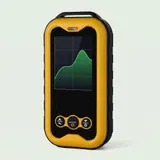
Every reading is indicative: this is a consumer radiation detector for general information, not a calibrated measuring instrument, not protective equipment and not a radon test. If you see an unusually high or persistent level, move away from the object, do not handle it, and contact the UK Health Security Agency or your local authority; in an emergency, call 999. Geiger Counter Shop sells one pocket counter for this kind of check: a glass GM tube (J321 type as listed by the supplier) for beta, gamma and X-rays, a 2.4-inch colour screen with µSv/h, CPM and a trend graph, adjustable alarms and a 1,800 mAh USB-C battery, delivered free from a UK warehouse for UK orders.
- Measure background first, in the same room.
- Keep the same distance for every object.
- Read CPM and averages, not single peaks.
- Compare CPM only on the same counter: figures from different counters do not match.
Frequently asked questions
What will set off a Geiger counter at home?
Mostly the old uranium and radium pieces the EPA lists: uranium glass, some uranium-glazed tableware made before 1973 and luminous dials without a battery, when the counter is held close. Some granite and rocks can raise the count too. Whether the alarm sounds depends on the threshold you set, so a beep alone is not a verdict: compare the average with your background.
What common items give off radiation?
Background radiation is everywhere, from minerals in the ground, water and cosmic radiation, according to the EPA. Among everyday items, the usual examples are potassium-rich foods such as bananas and Brazil nuts, potassium chloride salt substitutes, granite, ionisation smoke alarms with their americium-241, and older uranium glass and radium dials. Containing radioactive material does not mean a pocket counter will show it.
Do I need a licence to own a Geiger counter?
No. Owning a consumer Geiger counter that comes without a radioactive source needs no licence or authorisation in the UK or the US. The counter described here ships with no test source in the box. Smoke alarms follow a similar logic: according to the EPA, their manufacturers hold a licence from the US Nuclear Regulatory Commission and buyers do not need one.
Can a Geiger counter tell me whether an old plate can be used for food?
No. A pocket counter is not a food test and gives no verdict on an object, whatever number it shows. For old uranium-glazed tableware and uranium glass, the EPA's advice does not depend on a reading: do not serve food or drink in them, because of chips, and ask your local authority how to dispose of a broken piece.
Sources
- U.S. EPA, Radioactivity in Antiques
- U.S. EPA, Granite Countertops and Radiation
- U.S. EPA, Natural Radioactivity in Food
- U.S. EPA, Americium in Ionization Smoke Detectors
- Society for Radiological Protection (SRP), Our Radioactive Home
Our guides are based on the supplier's listings and public documentation. We have not tested the counter ourselves.


