
The short answer: rate now, dose over time, or more sensitivity
Each of the three answers a different question. A Geiger counter asks how much is happening right now. Its Geiger-Muller tube is a wire running through the centre of a gas-filled cylinder held at high voltage: HyperPhysics (Georgia State University) explains that a particle ionising a few gas molecules triggers an avalanche of electrons, which gives a pulse of current, and the counter turns each pulse into a click. The count rate (CPM or CPS) is then converted into an estimated dose rate in µSv/h. A dosimeter asks how much dose has built up over hours, days or months.
A scintillator answers the first question with a different sensor. Rather than a gas tube, it uses a crystal that gives off small flashes of light when radiation passes through it, and the electronics count those flashes. For gamma, that makes it more sensitive than a pocket-sized Geiger-Muller tube, and many consumer models also plot a spectrum. A pocket Geiger counter is not a calibrated measuring instrument or protective equipment, and its readings remain indicative.
Regulatory dosimeters versus a cumulative dose mode
When people who work with radiation talk about a dosimeter, they usually mean a badge. The worker wears it, and a laboratory reads it afterwards to record the dose received. That record sits within a workplace dosimetry programme with its own rules. A consumer counter's cumulative dose mode works differently: it takes its own dose-rate estimate and adds it up over time, in µSv. That is handy for curiosity and for comparing one day with another, but the total is indicative and never a regulatory dosimeter reading.
For context, UKHSA's Ionising radiation: dose comparisons page puts the average exposure in the United Kingdom at about 2.6 mSv a year, while the EPA's Radiation Sources and Doses page gives about 6.2 mSv (620 mrem) per person per year in the United States, citing the NCRP. The EPA's Radiation Terms and Units page adds that effective dose is a calculated estimate that does not predict an effect on a person. These figures are reference points to read a total against, not a line between good and bad.
| Feature | Geiger counter with a dose mode | Scintillation counter |
|---|---|---|
| Sensor | Gas-filled Geiger-Muller tube (glass on the pocket model described here) | Crystal that turns radiation into flashes of light |
| Gamma sensitivity | Lower for a pocket-sized tube | Higher |
| What it shows | Dose rate now and average (µSv/h), CPM or CPS, cumulative dose (µSv) | Readings plus, on many consumer models, a spectrum |
| Accumulated dose | Indicative cumulative dose mode, not a regulatory dosimeter | Not a regulatory dosimeter either |
| Public price (September 2026) | About £37 to £81 (UK listings, VAT included) | Clearly higher than a pocket Geiger counter |
| Best fit | Curiosity, objects you already own, travel | Finer gamma detail and a spectrum |
What a pocket Geiger counter with a dose mode shows
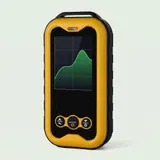
Take a pocket counter built around a glass Geiger-Muller tube (J321 type, as listed by its supplier) with a 2.4-inch colour screen. It shows the real-time dose rate and an average dose rate in µSv/h, the count rate in CPM or CPS, and a cumulative dose in µSv. A timed dose runs for a period you set, up to 999 hours. A trend graph plots the dose rate over time. Two alarms, one on dose rate and one on dose, have adjustable thresholds and can sound, flash or vibrate. The data stays in memory after the power goes off.
Its limits matter just as much. The tube detects beta, gamma and X-rays, not alpha. The manufacturer gives a dose rate range of 0.01 µSv/h to 50 mSv/h and an energy response of 48 keV to 1.5 MeV; above that range the screen shows "999 MAX". On beta sources the µSv/h figure runs high because the tube has no beta shield, so read CPM instead, and never compare CPM between different counters. The built-in 1,800 mAh battery charges over USB-C. For long timed doses, battery life matters: the manufacturer states 30 days or more in long-life mode, while an independent test found about 5 days in normal use.
Scintillation counters: the honest step up
If gamma sensitivity is what you are after, a scintillation counter is the natural next step. Its crystal responds to gamma more readily than a pocket-sized Geiger-Muller tube, and many consumer models add a spectrum, which spreads the counts out by energy rather than showing a single total. Consumer scintillation counters with a spectrometer sit in a clearly higher price bracket than pocket Geiger counters. That extra money buys sensitivity and detail. It does not buy a workplace dose record: a consumer scintillator is no more a regulatory dosimeter than a Geiger counter is.
For someone who wants to watch a reading climb near an old piece of uranium glass, or follow background levels on a trip, a Geiger counter covers the need. A scintillator makes sense when you want finer gamma detail or a spectrum and accept the higher price. Public UK listings in September 2026 showed consumer Geiger counters at about £37 to £81, VAT included. Either way, the reading is indicative.
Which one for which use
Curiosity and collections: if you already own uranium glass, pre-1973 uranium-glazed pottery or an old luminous dial, the EPA's Radioactivity in Antiques page notes that these objects can make a Geiger counter react when it is held near them. Keep them intact, never take apart a radium dial, do not serve food or drink in them, and wash your hands after handling them. A broken piece is a question for your local authority. Travel: a flight suits the cumulative dose mode, since cosmic radiation rises with altitude, and UKHSA gives about 0.08 mSv for a transatlantic flight.
The battery holds about 6.7 Wh, well under the 100 Wh limit that the US FAA PackSafe guidance sets for lithium-ion batteries in personal devices, but check your airline's rules. Work: a workplace follows its own rules, and its dosimetry programme decides what you wear and how dose is recorded. Whatever the use, if a reading is unusually high or persistent, move away from the source, do not handle the object and contact the UK Health Security Agency (UKHSA) or your local authority. In an emergency, call 999.
The 3-in-1 "radiation" gadgets that mostly read EMF
Some cheap devices sold as radiation detectors, often listed as 3-in-1 meters at around £13 to £28 in September 2026, are mostly electromagnetic field (EMF) meters. They are not Geiger counters, scintillators or dosimeters. The word "radiation" on the box covers something else entirely: an EMF reading has nothing to do with the beta, gamma and X-ray events that a Geiger-Muller tube counts. Before buying, look for a named detector, a Geiger-Muller tube or a scintillation crystal, and a dose rate in µSv/h.
The reverse holds too. A Geiger counter does not detect EMF, Wi-Fi, microwaves or 5G, and it does not measure radon: UKHSA and the EPA point to a radon test kit for that. It is not a food or water test either. Geiger Counter Shop sells one pocket Geiger counter with a glass GM tube (J321 type as listed by the supplier), a 2.4-inch colour screen, µSv/h and CPM, a trend graph, alarms and a USB-C battery, sent free from stock in your country (UK or US).
Frequently asked questions
Is a Geiger counter a dosimeter?
Not in the regulatory sense. A dosimeter used at work is typically a badge that a laboratory reads to record the dose a worker received. A pocket Geiger counter with a cumulative dose mode adds up its own dose-rate estimate, which is useful for comparing a flight with an ordinary day, but the total is indicative, not an official dose record.
Can I use a consumer Geiger counter for my job?
Not as your dose record. If your work involves radiation, a workplace dosimetry programme decides which dosimeter you wear and how dose is recorded, and a consumer counter does not replace it. Owning one out of personal curiosity is a different matter: a consumer Geiger counter without a radioactive source needs no licence. For anything work-related, ask whoever runs that programme.
Which is more accurate, a Geiger counter or a scintillator?
For gamma, a scintillation counter is more sensitive than a pocket-sized Geiger-Muller tube, and many show a spectrum. Neither consumer device replaces a calibrated measuring instrument. For the pocket counter described here, the manufacturer quotes a relative error under 10% at 1 mSv/h on its own reference, which is not a calibration certificate. Readings take time to settle, so judge an average over several minutes.
Sources
Our guides are based on the supplier's listings and public documentation. We have not tested the counter ourselves.


