
The short answer from the EPA
Granite is a natural stone, made of minerals that formed in the ground. The EPA page on granite countertops and radiation says granite can contain traces of naturally occurring radioactive elements, and that those traces give off a little beta and gamma radiation. The EPA adds two points that shape everything else in this guide. First, the amount varies from one stone to another, so a result from one slab tells you nothing certain about the next. Second, the radiation drops quickly with distance, so what a counter reads when it lies on the surface is not what is present a step back from the kitchen island.
That is the whole short answer: some granite shows a small amount of radioactivity, and the only way to see how your own worktop compares with its surroundings is to check it. The EPA gives no single figure for granite, and neither does this guide. It also notes that radon rising from the ground beneath a house is a far more common subject than the stone in the kitchen, which we come back to below. Whatever a pocket counter shows on a worktop is indicative, not a measurement you can quote.
Why granite can be slightly radioactive
Rocks and soils carry traces of uranium and thorium. The UK Society for Radiological Protection (SRP) wrote in its 2016 article "Our Radioactive Home" that these traces exist in rocks and soils across the United Kingdom, in places at levels that make a Geiger counter click, giving the example of a pebble brought back from Cornwall. Granite is one of the rocks that can hold such traces, as the EPA says of worktops. Some uranium minerals even form in it: torbernite, a green copper and uranyl phosphate described as radioactive, is found in granites. A slab that holds a little more of these elements can give off a little more beta and gamma than its surroundings.
A polished worktop is not a mineral specimen, though. It is a large cut and finished slab, and its content varies from one stone to the next, as the EPA notes. So do not expect every granite worktop to make a counter click faster, and do not expect two slabs that look alike to read the same. If you want to look more closely at the minerals themselves, from torbernite to autunite and uraninite, our guide to radioactive rocks covers them in more detail, with the same measuring method.
| Question | What a pocket counter can tell you | What it cannot tell you |
|---|---|---|
| Does my worktop read above background? | Whether the average CPM on the stone is higher than in another room, on the same counter | A precise value: the EPA says that takes calibrated instruments and a trained user |
| How much radiation does it give off? | An indicative CPM count and dose rate at the spot you checked | An exact figure; on beta the µSv/h reading runs high, so CPM is the better guide |
| Is one slab different from another? | Whether two slabs read differently on the same counter, at the same spot and distance | Why they differ, or which type of stone reads higher in general |
| Does distance matter? | How the count changes as you move the counter away from the surface | The dose anyone in the kitchen actually receives |
| Is there radon in my home? | Nothing: a Geiger counter is not a radon test | Any radon level; for that, use a radon measurement pack (UKHSA, ukradon.org) |
| Should I be concerned about a reading? | Whether a reading is unusually high or persistent, the cue to move away and contact the authority | A health verdict; it is not personal protective equipment |
What a Geiger counter shows on a worktop
The honest way to use a pocket counter here is as a comparison, not a single number. Start in another room, away from the kitchen, and let the counter run for a few minutes to see your background. Note the CPM (counts per minute) and watch the trend graph rather than one moment, because the reading takes time to settle. For reference, one independent test found about 20 CPM at background with a glass tube of the J321 type. Then place the counter on the stone, at the same spot and the same distance each time, and let it run for the same few minutes. Compare the average CPM on the stone with the average in the other room.
Read the CPM rather than the µSv/h figure. Granite gives off beta as well as gamma, and on beta a glass tube without a beta shield makes the µSv/h reading run high, as an independent test pointed out. CPM is the raw count from the tube, but it only compares with itself: CPM from two different counters cannot be compared. A pocket counter can show a difference between the stone and your background. It cannot tell you precisely how much radiation the worktop gives off: the EPA says that takes calibrated instruments and a trained user.
- The same counter for every reading, since CPM does not compare between devices
- The same spot on the stone and the same distance, for example the counter lying flat on the surface
- The same duration, a few minutes each, and the average rather than a single peak
- A note of the date, the room and the result, so you can repeat the check later
Radon is the far more common question
When people ask about radiation at home, the EPA points to radon rather than to worktops. Radon comes from the ground beneath a house, and the EPA calls it a far more common issue than the stone in a kitchen. A Geiger counter is not a radon test. It does not measure a concentration of radon in the air, and it cannot tell you whether a room has a radon problem. Its glass tube does not see alpha particles either. In the UK, radon is measured with a radon measurement pack from UKHSA, available through ukradon.org, and the radon Affected Areas maps there show where testing is advised.
So if your real question is whether your home has a radon issue, the tool you need is a radon measurement pack, not a Geiger counter held over the stone. Our radon guide explains in more detail why a handheld counter misses radon and what it can still show. A worktop check with a Geiger counter and a radon test answer two different questions, and one never stands in for the other.
Marble, quartz and other stones
Searches for "is marble radioactive" often turn up next to granite. We have no verified figures for marble, quartz surfaces, slate or any other stone, so this guide makes no claim about which reads higher or lower. What can be said is general: natural stones vary, as the EPA says of granite, and the SRP describes traces of uranium and thorium in rocks and soils generally. The measuring method stays the same whatever the stone: background in another room first, then the stone at the same spot and distance, a few minutes each, and a comparison of average CPM on the same counter.
Be careful with comparisons between two kitchens or two showrooms. Background itself changes from place to place, the EPA notes, and it rises with altitude, so a worktop in a house high in the hills and one at sea level do not start from the same baseline. Always compare a stone with the background of the building it sits in, using the same counter, rather than with a number found online or taken from another device.
When to ask for help
Readings from a pocket counter are indicative, and a single high moment is not a result: first check that the reading holds over several minutes and comes back in a second session. If you measure an unusually high or persistent level, move away from the source, do not handle the object, and contact the competent authority: in the UK, the UK Health Security Agency (UKHSA) or your local authority. In an emergency, call 999. The same steps apply to any object you check, not only to stone, and they come before any further measuring of your own.
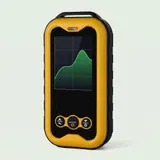
Keep the limits of the device in mind. A consumer Geiger counter is for general information only: it is not a calibrated measuring instrument, not personal protective equipment and not a radon test. It does not detect alpha particles, it does not detect EMF or 5G, and it is not a tool for testing food or water. Geiger Counter Shop sells one pocket counter of this kind, with a glass GM tube (J321 type as listed by the supplier), a 2.4-inch colour screen, µSv/h and CPM, a trend graph, alarms and a USB-C battery, shipped free from stock in the UK or the US.
Frequently asked questions
How much radiation does granite give off?
There is no single number. The EPA says the amount varies from one stone to another and drops quickly with distance, and it gives no standard figure for granite. The useful question with a pocket counter is how your own worktop compares with your own background, measured the same way on the same device. Treat the result as indicative, not as a measured dose.
Do granite worktops give off radon?
The EPA points out that radon from the ground beneath a house is a far more common issue than granite worktops. Either way, a Geiger counter cannot answer the question, because it does not measure radon in the air. To find out about radon at home in the UK, use a radon measurement pack from UKHSA, available through ukradon.org.
Is it worth checking my worktop with a Geiger counter?
As a curiosity, yes, if you keep the limits in mind. A pocket counter can show whether the stone reads above your background and how that changes as you move away. It gives an indicative reading, not a survey of your kitchen, not a radon result and not a health verdict. For a precise measurement, the EPA says you need calibrated instruments and a trained user.
Sources
- U.S. EPA, Granite Countertops and Radiation
- U.S. EPA, Find a Radon Test Kit or Measurement and Mitigation Professional
- UKHSA, UK Radon
- Society for Radiological Protection (SRP), Our Radioactive Home
- U.S. EPA, Radiation Basics
Our guides are based on the supplier's listings and public documentation. We have not tested the counter ourselves.


