
What uranium glass, uranium-glazed pottery and radium dials are
The EPA's page on radioactivity in antiques describes three families of objects that collectors come across often. The first is uranium glass, also called vaseline glass or canary glass. A small amount of uranium gives it a yellow-green colour, and under a UV lamp it glows a bright green, the trait most collectors recognise it by. The second is old uranium-glazed pottery: the EPA notes that some pre-1973 American dinnerware has a glaze that contains uranium. The third is the radium dial, found on older clocks and watches whose hands and numerals glow without a battery. The luminous paint on those dials can contain radium.
These pieces turn up in family cupboards, house clearances and display cabinets, and many owners only learn about the uranium or radium years later. The EPA also notes that such objects can make a Geiger counter react when it is held close to them. That is why a UV lamp and a counter are the two tools people reach for. A check tells you whether a piece belongs to one of these families. It does not grade the piece, and it does not replace the EPA's handling advice.
Check in two steps: UV torch first, then the counter
Start with the UV torch, because it is quick and needs no numbers. In a dim room, shine the UV light on the piece. Uranium glass answers with the bright green glow the EPA describes. The EPA links that glow to glass, so for glazed pottery and clock or watch dials, the counter step carries more of the weight. A piece that does not glow simply gives you no sign from this step. Note the result, leave the piece where it is, and move on to step two with the same object.
Step two is a comparison, never a single number. Let the counter run for a few minutes away from the collection and note its average: that is your background. The EPA points out that background varies from place to place and rises with altitude, so take it where you are. Then hold the counter at the same short distance from each object and let it run a few more minutes. An independent test found that readings take time to settle on a source, and time to fall back after a more active object, so compare averages, not the first figure.
| Object | Quick sign | Counter reading compared with background |
|---|---|---|
| Vaseline or canary glass | Yellow-green glass that glows bright green under a UV lamp (EPA) | Can read above background when held close |
| Old uranium-glazed pottery | Some pieces made before 1973, such as some American dinnerware, have a glaze containing uranium (EPA) | Can read above background when held close |
| Radium dial clock or watch | Hands or numerals that glow without a battery (EPA) | Can read above background when close; never open the case |
| Green glass look-alike | No bright green glow under the UV lamp | Without uranium, its average should match your background average |
| Any of these at arm's length | Same piece, counter moved away | Drops back towards background quickly, as radiation falls off with distance (EPA) |
What the counter shows, and what it does not
Held close, a glass-tube Geiger counter can register these objects, as the EPA says. Move it away and the reading drops quickly: the EPA notes that radiation falls off fast with distance, so a few centimetres change the result. What the counter cannot do is tell you how much uranium or radium a piece contains. It counts the events that reach its tube, and with a glass tube it does not detect alpha at all. It is not a radon test, not a food test and not an EMF or 5G meter. Nor is it a calibrated measuring instrument or protective equipment. Its readings are indicative.
When a source gives off beta, the dose rate in µSv/h runs high on this kind of counter, because the tube has no beta shield. An independent test advises reading CPM, the raw count, instead. CPM only makes sense on the same counter, so never compare your figure with a number from someone else's device. If a reading is unusually high or keeps climbing, move away, do not handle the object, and contact the UK Health Security Agency (UKHSA) or your local authority. In an emergency, call 999.
Handling old pieces: intact, closed and away from food
The EPA's handling advice is short, and it applies whatever the counter shows. Keep objects intact and in good condition. Never take apart a radium dial: leave the hands, the face and the glass of the clock or watch where they are. Never serve food or drink in old uranium glass or old uranium-glazed pottery, because chips can come away with use and end up where they should not. Keep them on a shelf, not in the cupboard with everyday crockery. Wash your hands after handling old objects.
A broken piece is the one case that calls for a question rather than a guess. The EPA's advice is to ask your local authority how to dispose of it, so keep the fragments together and set them aside until you have an answer. Do not put them in with kitchenware or the household rubbish before asking. If you are unsure who to contact first, your local council or the UK Health Security Agency (UKHSA) can point you in the right direction.
Displaying a collection calmly
A collection on display needs a few plain habits, not special equipment. A dedicated shelf or cabinet keeps pieces away from the kitchen and out of daily use, which fits the EPA's advice to keep old uranium glass and old uranium-glazed pottery away from food and drink. It also makes pieces easy to look over for chips. Labels help more than they seem to: a small card with the object, its approximate date and the result of your UV check keeps that information with the piece when it is moved, lent or passed on.
Handle pieces to look at them, dust them or rearrange the shelf, then wash your hands, as the EPA advises for old objects. Keep radium-dial clocks and watches closed and whole. If you keep a log of readings, write down the counter, the distance and the averaging time next to your background average, so that a later check on the same counter can be compared fairly.
At car boot sales and antiques fairs: telling uranium glass from look-alikes
At a car boot sale, a flea market or an antiques fair, the same two steps help you sort what is on the table. A UV torch shows the green glow of uranium glass in seconds, and a counter held close can show whether a piece reads above your background average. Together they help tell uranium glass from green or yellow glass that only looks similar. Neither tool tells you a piece's age, maker or value, and a counter reading says nothing about how much uranium is inside. No quick check is a promise, and none of this is a reason to take home a radioactive object.
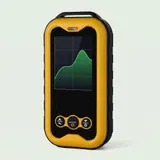
Choosing the counter itself is a separate question, covered in our guide to a Geiger counter for uranium glass. Geiger Counter Shop sells one pocket model: a yellow counter with a glass GM tube (J321 type as listed by the supplier), a 2.4-inch colour screen, µSv/h and CPM, a trend graph, adjustable alarms and a 1,800 mAh USB-C battery, sent free from UK stock for UK orders. Battery life is given two ways: 30 days or more in long-life mode per the manufacturer, about 5 days in normal use in an independent test.
Frequently asked questions
Is uranium glass a problem to keep at home?
The EPA's guidance is that old objects such as uranium glass are generally not a problem when they are intact and in good condition. The same guidance asks you not to use them for food or drink, to keep them from chipping and to ask your local authority about a broken piece. A pocket Geiger counter cannot answer this question for you: its readings are indicative, not a health judgement.
Will a Geiger counter detect uranium glass?
Yes, when it is close. The EPA notes that uranium glass can make a Geiger counter react when held near it. With a glass-tube counter, the average usually rises above background at a short distance and falls back quickly as you move away. The counter registers beta, gamma and X-rays, not alpha, so compare CPM averages on the same device.
Does uranium glass glow without UV light?
Not the way it does under a UV torch. In ordinary light it shows a yellow-green colour, and the bright green glow the EPA describes appears under a UV lamp. Objects that glow on their own, with no battery, are a different case: older clock and watch dials with luminous paint, which can contain radium. Keep those closed and intact.
Sources
Our guides are based on the supplier's listings and public documentation. We have not tested the counter ourselves.


