
The short answer: americium-241 in ionisation smoke alarms
The EPA explains that ionisation smoke detectors contain a very small amount of americium-241, a radioactive material that is a source of alpha particles. That is where the phrase "smoke alarm radiation" comes from: the source is there on purpose, because the alarm needs it to sense smoke. It is not a fault, a leak or a sign of a damaged unit. On health, we repeat the agency rather than add a verdict of our own: the EPA says there is no health threat while the alarm is undamaged and used as directed.
This guide covers ionisation smoke alarms only, because that is the type the EPA describes as holding americium. If you are not sure which type is fitted to your ceiling, the leaflet or manual that came with the alarm is the place to check, not the inside of the unit. The sections below explain how the source works, why its alpha particles stay put, what a pocket Geiger counter can tell you, and how to get rid of an old alarm.
How an ionisation smoke alarm uses its source
Inside the alarm, the americium-241 source sends alpha particles into a small pocket of air between two electrically charged plates. The EPA describes what happens next: the alpha particles ionise the air, turning some air molecules into charged particles called ions. Those ions move towards the plates, so a small, steady flow of ions runs between them. As long as that flow stays steady, the alarm stays quiet. The americium is built into the unit; it is never something the owner adds, moves or replaces.
When smoke enters that space, it breaks the flow of ions between the plates. The alarm notices the change and sounds. In other words, the radiation is not something the alarm measures in your room; it is an internal tool the alarm uses to notice smoke. Nothing in this process is meant to send alpha particles out into the room, and the next section explains why they stay in.
| Fact | What it means | Source |
|---|---|---|
| Ionisation smoke alarms hold a very small americium-241 source | The source gives off alpha particles, which the alarm uses to sense smoke | EPA, Americium in Ionization Smoke Detectors |
| Alpha particles ionise the air between two charged plates | Smoke breaks the flow of ions and the alarm sounds | EPA, Americium in Ionization Smoke Detectors |
| Alpha particles travel very little and cannot get through the outer layer of skin | They are stopped over a very short distance | EPA, Radiation Basics |
| The source sits in a layer of foil and ceramic | The layer keeps the alpha particles inside the alarm | EPA, Americium in Ionization Smoke Detectors |
| A glass Geiger-Muller tube registers beta, gamma and X-rays only | It does not register alpha particles, so not the alarm's source | Manufacturer data sheet |
| Never tamper with an alarm or remove the americium | Dispose of the whole unit: household rubbish or a local recycling scheme | EPA, Americium in Ionization Smoke Detectors |
Why the alpha particles stay inside the alarm
According to the EPA's radiation basics page, alpha particles are made of two protons and two neutrons and come from heavy elements such as uranium, radium and polonium. They travel very little and cannot get through the outer layer of skin. Beta particles go further in air and are stopped by clothing or a thin layer of aluminium, while gamma rays pass through those barriers and need a thick layer of lead or concrete to stop them. Alpha particles sit at the short-range end of that scale.
On top of that short range, the EPA explains that the americium in a smoke detector sits in a layer of foil and ceramic that keeps the alpha particles inside the unit. Two things work together: the particles do not travel far, and the source is enclosed. This is also why the EPA's advice about leaving the unit alone is so firm. Opening the case, prising at the chamber or trying to remove the source defeats the very packaging that keeps the alpha particles in.
What a Geiger counter can and cannot show
A Geiger counter counts pulses in a gas-filled tube: a particle that ionises a few gas molecules sets off an avalanche of electrons, and the counter turns each pulse into a click and a count. A pocket counter with a glass Geiger-Muller tube registers beta particles, gamma rays and X-rays, but it does not register alpha particles at all. The EPA, for its part, says the alpha particles do not leave the smoke detector. Put those two facts together and a glass-tube counter has no way to show you the alpha particles from the americium source.
What about holding the counter next to a closed alarm? We have found no published source that says what a glass-tube counter reads in that position, so we make no promise either way. Any reading is indicative only. Never open a smoke alarm to test it or to get closer to the source. If a counter ever shows an unusually high or persistent level anywhere, move away, do not handle the object and contact the UK Health Security Agency (UKHSA) or your local authority (call 999 in an emergency).
- Registers beta particles, gamma rays and X-rays; does not register alpha particles.
- Is not a radon test, not an EMF, Wi-Fi or 5G meter and not a food or water test.
- Is not a calibrated measuring instrument and not protective equipment: readings are indicative.
Handling and disposing of a smoke alarm
The EPA's handling advice, from its page on americium in ionisation smoke detectors, is short and clear. Never tamper with a smoke alarm and never try to remove the americium. Keep the unit whole, whether it is still on the ceiling, sitting in a drawer or on its way out of the house. The same page adds that, in the United States, the manufacturers hold a licence from the Nuclear Regulatory Commission and the buyer does not need one to buy or own an alarm.
When an alarm reaches the end of its life, the EPA says it can go out with household rubbish, or to a local recycling scheme where one exists. If you are unsure how your area wants old alarms handled, ask your local authority. Most detectors have a useful life of ten years, according to the EPA, so replacing an old unit is a routine job. Either way, the alarm leaves the house closed and intact.
Other radioactive things you may find at home
Smoke alarms are only one item on a longer list. The EPA notes that uranium glass, some Fiestaware made before 1973 with a uranium glaze, and old self-luminous watch and clock dials that may contain radium can make a Geiger counter react when it is held close. The UK Society for Radiological Protection adds that rocks and soil carry traces of uranium and thorium, in places at levels that make a Geiger counter click. Anything with potassium also carries traces of potassium-40, which is why bananas come up so often. Our guide to radioactive household items goes through them one by one.
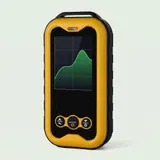
With old objects, the EPA advises keeping them intact, never taking apart a radium dial, not serving food or drink in old Fiestaware or uranium glass, and asking your local authority if a piece breaks. Washing your hands after handling them is a good habit too. If you want to look at objects you already own, Geiger Counter Shop sells one pocket Geiger counter with a glass GM tube (J321 type as listed by the supplier), a 2.4-inch colour screen, µSv/h and CPM, a trend graph, alarms and a USB-C battery, shipped free from stock in the UK.
Frequently asked questions
Which smoke alarms contain americium?
The EPA names ionisation smoke detectors as the ones that hold a very small americium-241 source. If you are not sure whether yours is an ionisation model, read the manual or leaflet that came with it for the detection type, and leave the case closed while you check. Opening it to look inside is exactly what the EPA advises against.
Will a Geiger counter pick up a smoke alarm?
Not its alpha source, if the counter uses a glass tube: that tube does not register alpha particles, and the EPA says the alpha stays inside the unit. We know of no published source on what such a counter shows beside a closed alarm, so there is no promise either way. Do not open the alarm to find out.
Can I throw an old smoke alarm away?
The EPA says an old smoke detector can go out with household rubbish, or to a local recycling scheme where one exists. Leave it whole: do not take it apart and do not try to remove the americium. If you are unsure how your area handles old alarms, ask your local authority. Most detectors have a useful life of ten years according to the EPA.
Sources
- U.S. EPA, Americium in Ionization Smoke Detectors
- U.S. EPA, Radiation Basics
- Society for Radiological Protection (SRP), Our Radioactive Home
Our guides are based on the supplier's listings and public documentation. We have not tested the counter ourselves.


