
What collectors actually find
Most vintage radiation instruments that turn up today at auctions, car boot sales or in a relative's loft share a look: a sturdy metal case, a carrying handle and an analogue meter with a needle sweeping across a printed scale. Some are survey meters with a separate probe on a cable. A good number were made for Cold War civil defence use, and their stencilled markings are a big part of their appeal to collectors. The detail that matters most sits inside. Many of these units are ion-chamber survey meters, designed to read high radiation levels, not Geiger counters sensitive enough to register everyday background radiation.
That difference matters more than age. A Geiger-Muller tube is a wire at the centre of a gas-filled cylinder under high voltage: a particle that ionises a few gas molecules sets off an avalanche of electrons, and the instrument turns each pulse into a click (HyperPhysics, Georgia State University). A high-range ion-chamber meter is not built to react to the low levels found in a home. Before judging a unit, find out which kind you own.
Do they still work? You cannot tell by looking
Decades in a loft, a shed or a garage are hard on electronics. Old units took battery types that may be difficult to find today, and batteries left inside can leak and corrode the contacts. Geiger tubes themselves do not last forever. A needle that moves when you switch the unit on only tells you the circuit has some power, not that the detector responds correctly. The honest answer is that nobody can say from a photo, an auction listing or a quick look whether a given unit still measures anything.
Reading silence is tricky too. An ion-chamber meter resting at zero in your sitting room is not proof that it is broken, since it was never meant to read that low. An old Geiger unit that stays completely silent at background is more suspicious, because a working tube normally clicks now and then. Either way, a reading from a decades-old instrument is not something to rely on. These instruments contain high-voltage circuits, and this guide gives no repair instructions.
| Point | Vintage unit | Modern pocket counter |
|---|---|---|
| What it detects well | Often high levels only (ion-chamber meters); old Geiger units only if the tube still works | Beta, gamma and X-rays with a glass GM tube, down to background; no alpha |
| Battery | Older cell types; leaks and corroded contacts are possible | Built-in 1,800 mAh, USB-C; 30 days or more in long-life mode (manufacturer), about 5 days in normal use (independent test) |
| Display | Needle on an analogue scale, often in mR/h, with a range switch | 2.4-inch colour screen: µSv/h, CPM, cumulative dose and a trend graph |
| Reading background | Ion-chamber units usually show zero; aged Geiger units may be unreliable | Clicks at background; about 20 CPM in one independent test of this tube type |
| Best use today | Display piece and a bit of history | Indicative readings of background and everyday objects |
Old calibration labels and check sources
Many surplus meters still carry a calibration sticker or a date left by whoever last serviced them. That date describes the instrument as it was decades ago, not as it is today: components drift and tubes age, so the old label no longer tells you how far to trust the needle. Some older units also carry a small check source, a tiny radioactive sample built into the case or the probe so that an operator could confirm the meter responded.
If your unit has one, leave it exactly as it is. Do not open it, prise it off, scrape it or clean it, and keep the instrument away from children. Wash your hands after handling it. If the source looks damaged, loose or broken, or if you are not sure what you have, stop handling it and ask the UK Health Security Agency (UKHSA) or your local authority. They can also explain how to dispose of it properly.
Keeping them as objects versus using them
There is nothing wrong with keeping a vintage meter on a shelf. A unit that no longer measures anything can still be a fine piece of history. The problem starts when an old instrument is treated as a working reference. The US Environmental Protection Agency (EPA) notes that uranium glass can make a Geiger counter react when it is held close to it. If a vintage needle stays at zero next to such a piece, that may say more about the meter's range or condition than about the glass.
For reading background, a modern Geiger counter is the practical tool. According to the EPA, background radiation comes mostly from minerals in soil and water and from cosmic radiation, varies from place to place and rises with altitude. A pocket counter with a Geiger-Muller tube clicks at that level, so you can watch the numbers and the trend instead of wondering whether a needle is stuck. Its readings are still indicative, not those of a calibrated measuring instrument.
Reading an analogue scale versus a digital screen
Modern pocket counters show an estimated dose rate in microsieverts per hour (µSv/h) and counts per minute (CPM). Vintage meters usually show an exposure rate on a needle scale, often in milliroentgens per hour (mR/h). For dose, the EPA gives these conversions: 1 µSv = 0.1 mrem, 1 mSv = 100 mrem and 1 Sv = 100 rem. For context, UKHSA puts average exposure in the UK at about 2.6 mSv a year, and the EPA gives 6.2 mSv (620 mrem) a year per person in the US. These are averages, not thresholds.
CPM is the raw count of a tube, so it only compares with readings from the same counter: two different instruments give different CPM in the same spot. Treat any reading as indicative. If you see an unusually high or persistent reading near an old object, move away, do not handle it, and contact UKHSA or your local authority. In an emergency, call 999.
Where a modern pocket counter fits
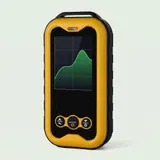
For everyday levels, Geiger Counter Shop sells one pocket counter: a yellow unit with a glass Geiger-Muller tube (J321 type, as listed by the supplier) that detects beta, gamma and X-rays, a 2.4-inch colour screen showing dose rate in µSv/h and counts in CPM, a dose-rate trend graph and two adjustable alarms by sound, flashing light or vibration. Its built-in 1,800 mAh battery charges over USB-C; the manufacturer quotes 30 days or more in long-life mode, while an independent test found about 5 days in normal use. UK orders ship free from stock held in the UK.
Its limits are worth stating plainly. The glass tube does not detect alpha, and it has no beta shield, so on a beta source the µSv/h figure runs high: read CPM instead. It is not a radon test, does not measure EMF or 5G, does not test food or water, and it is not a calibrated or protective instrument. Next to a vintage meter, it is the tool for background, and the old unit stays the collectable.
Frequently asked questions
Are old Geiger counters radioactive?
Some contain a radioactive part on purpose: a small check source, meant to stay sealed for the life of the instrument. Leave it attached and closed, never try to remove it, and wash your hands after handling the unit. If you are not sure what yours contains, or it looks damaged, ask the UK Health Security Agency (UKHSA) or your local authority.
Can I use a Cold War counter today?
As a curiosity, yes, if it powers up; as a reference, not really. Many were high-range ion-chamber meters that will not show everyday background, and the Geiger models among them have aged tubes and circuits whose accuracy nobody can vouch for today. For background, rely on a modern counter, whose readings are still indicative.
Are vintage Geiger counters worth money?
It depends on the collectors' market, which varies with the type of unit, its condition, whether the probe and manual are still with it, and demand at the time. There is no reliable price list, so this guide gives no figures. A unit's value as a collectable has little to do with whether it still measures accurately: judge it as an object, not as an instrument.
Sources
Our guides are based on the supplier's listings and public documentation. We have not tested the counter ourselves.


