
What a Geiger-Muller tube is and how it counts
HyperPhysics, the physics reference published by Georgia State University, describes a Geiger tube in a few parts. A thin wire runs down the centre of a cylinder filled with gas, and a high voltage is held between the wire and the cylinder wall. As long as nothing ionises the gas, the tube stays quiet. When a particle or a photon ionises a few gas molecules, the electric field draws the freed electrons towards the wire, they free more electrons along the way, and the process turns into an avalanche. That avalanche is a brief pulse of current, and the counter converts it into a click and one more count.
The point that matters for buyers is that the tube counts events; it does not identify them. One event gives one pulse, whether a beta particle, a gamma photon or an X-ray set it off, so the tube cannot tell you which isotope is present. Everything a counter displays, including counts per minute (CPM) and an indicative dose rate in µSv/h, is worked out from that stream of pulses. The size of the tube, its wall and its window decide which events can reach the gas in the first place.
Glass tubes, short tubes and mica-window pancake probes
Most pocket counters use a glass GM tube. The J321 type is a common example: a slim glass cylinder. Its glass wall lets gamma rays, X-rays and higher-energy beta particles through, but it stops alpha particles, so a glass tube cannot see alpha at all. Shorter tubes of the J614 type fit into smaller cases. According to the maintainer of an open-source Geiger counter firmware, they are less sensitive at background than a J321, which means fewer counts to work with over the same period.
A pancake probe is a different design: a flat, wide GM tube closed on one face by a very thin mica window rather than a glass wall. That thin window is what allows alpha particles to reach the gas, so a mica-window pancake probe can see alpha as well as beta and gamma, which no glass tube can. The flat face also presents a larger area to a surface than a slim cylinder does. If seeing alpha matters for what you want to look at, a glass-tube pocket counter is the wrong tool, whatever its screen or features.
| Detector type | What it sees | Typical use |
|---|---|---|
| Glass GM tube, J321 type | Beta, gamma and X-rays; no alpha | Pocket counters: background, uranium glass, trends over time |
| Short glass GM tube, J614 type | Beta, gamma and X-rays; no alpha; fewer counts at background | Smaller counters where size matters more than count rate |
| Mica-window pancake probe | Alpha as well as beta and gamma | Surface checks where alpha matters |
| Scintillation detector (not a GM tube) | More sensitive to gamma than a pocket GM tube | Consumer spectrometers, in a clearly higher price bracket (September 2026) |
Sensitivity: why tube size changes the count
Sensitivity is largely a question of size. A bigger tube offers more gas volume and more wall area for radiation to strike, so at the same background it records more counts per minute than a smaller one. More counts over the same period means a steadier average and a quicker sense of whether something has changed. One independent test measured about 20 CPM at background with a glass J321-type tube. That figure belongs to that tube in that place: the US Environmental Protection Agency (Radiation Sources and Doses) notes that background varies from one location to another and rises with altitude, so your own figure may well differ.
This is also why CPM cannot be compared between different counters. A short J614-type tube and a J321-type tube placed side by side will show different CPM for the same radiation, and neither is wrong. Only compare a counter with itself: the same device, in the same spot, over time. Consumer scintillation counters with a spectrometer, a different type of detector that sits in a clearly higher price bracket than pocket Geiger counters, are more sensitive to gamma than a pocket-sized GM tube.
DIY Geiger counter kits and boards
Geiger counter kits and bare boards are available, and they appeal to hobbyists who want to see how the parts fit together. They all share one requirement: the tube needs a high-voltage supply to work, and that part of the circuit calls for care and experience. This guide deliberately gives no wiring, circuit or assembly instructions. If you are new to electronics, the sensible route is an assembled, enclosed counter, where the high-voltage section stays sealed inside the case and the only port you use is the charging connector.
A kit also leaves the practical work to you: the case, the power supply, the display and reading the counts correctly. For comparison, assembled consumer Geiger counters listed in the UK cost roughly £37 to £81 in September 2026. Be wary of cheap '3 in 1' devices sold as radiation detectors for about £13 to £28: they are mostly electromagnetic field meters, not Geiger counters. Owning a consumer Geiger counter with no radioactive source needs no licence or permit in the UK.
What a J321-type glass tube means in a pocket counter
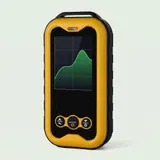
Geiger Counter Shop sells one pocket Geiger counter, dispatched free from a UK warehouse for UK orders, and it is built around a glass GM tube of the J321 type, as listed by the supplier. In practice that means beta, gamma and X-rays, and no alpha. The manufacturer gives an energy response of 48 keV to 1.5 MeV and a dose rate range of 0.01 µSv/h to 50 mSv/h. The counter shows CPM or CPS, real-time and average dose rate in µSv/h, a cumulative dose mode and a dose-rate trend graph on a 2.4-inch colour screen, with two adjustable alarms and a built-in 1,800 mAh USB-C battery.
The glass tube has no beta shield, so close to a beta source the µSv/h figure runs high; read the CPM, the tube's raw count, instead. Uranium glass can make the count climb when held close: keep such pieces intact, never serve food or drink in them, and wash your hands after handling them. Readings are indicative. This is not a calibrated measuring instrument, not a radon test and not a food test. If a reading is unusually high or persistent, move away, do not handle the object and contact the UK Health Security Agency (UKHSA) or your local authority; in an emergency, call 999.
Tube ageing and replacement on a sealed counter
On a DIY board, the tube is a part you can see and swap. On a sealed consumer counter it is not a user part. The tube sits inside the case next to the high-voltage circuit, and the built-in battery is not user-replaceable either, so opening the counter to change or inspect the tube is not something an owner should do. Treat it as a closed device: charge it with the supplied USB-C cable, keep it dry, since no water resistance rating is published, and never heat or pierce it.
If the readings look odd, check the simple causes before suspecting the tube. One independent test noted that the reading takes time to settle on a source and to drop back to background after a more active object, so give it several minutes. Compare the counter with its own earlier readings in the same spot, not with another device or with figures from official monitoring stations, which use different units, heights and calibration. If it still seems wrong, email customer service rather than opening the case.
Frequently asked questions
Can I build my own Geiger counter?
Yes, kits and boards are available for hobbyists. Every design needs a high-voltage supply for the tube, so building one calls for electronics experience and care, and this guide gives no wiring or circuit instructions. If you mainly want to look at background or at objects such as uranium glass, an assembled counter with its high-voltage section sealed inside the case is the simpler choice.
What is a pancake probe?
It is a flat, wide Geiger-Muller tube whose face is a very thin mica window rather than glass. Alpha particles can pass through that window, so this kind of probe picks up alpha in addition to beta and gamma, which a glass tube cannot do. Its broad face also covers more surface at once than a slim cylindrical tube.
Which tube is in your counter?
A glass Geiger-Muller tube of the J321 type, as listed by the supplier. The shop has not opened a counter to check it, since the unit is sealed. That tube type means beta, gamma and X-rays, and no alpha. One independent test advised checking that a listing names the J321 tube, because some batches have shipped with other tubes; the supplier's listing names it.
Sources
Our guides are based on the supplier's listings and public documentation. We have not tested the counter ourselves.


