
What a Geiger counter is
A Geiger counter is a radiation detector built around a single component, the Geiger-Muller (GM) tube. A small circuit supplies the high voltage the tube needs, a counter tallies the pulses it produces, and a screen or speaker shows the result. The tube does not tell you which isotope is present. It answers a narrower question: how many ionising events reached it in a given time. That count is the raw measurement; the dose rate shown beside it is a calculation built on top of the count.
According to the US EPA (Radiation Sources and Doses), background radiation comes mostly from minerals in the ground, from water and from cosmic radiation. It varies from place to place and rises with altitude; for context, UKHSA's dose comparisons put a transatlantic flight at about 0.08 mSv. A pocket counter shows those differences as numbers and as a trend over time, with indicative readings.
Inside the Geiger-Muller tube
HyperPhysics, the physics reference published by Georgia State University, describes the tube simply: a wire runs down the centre of a gas-filled cylinder, with a high voltage between the wire and the cylinder wall. As long as nothing ionises the gas, the tube stays quiet. When a particle or a photon ionises a few gas molecules, the strong electric field draws the freed electrons towards the wire. On the way they knock loose more electrons, and the process multiplies into an avalanche.
The avalanche produces a brief pulse of current. One event gives one pulse, whatever caused it, so the tube tallies events rather than identifying where they came from. The counter turns each pulse into a click, adds it to the running total and works out the figures on the screen from that total. One pulse per event, counted over time: that is the whole principle.
| Radiation type | What stops it | Does a glass-tube counter pick it up? |
|---|---|---|
| Alpha | A sheet of paper, the outer layer of skin, or the glass wall of the tube | No, it cannot get through the glass |
| Beta | A thin layer of plastic or a light metal such as aluminium | Yes, higher-energy beta; µSv/h reads high, so read CPM |
| Gamma | Reduced by thick, dense material such as lead or concrete | Yes, the µSv/h conversion is set for gamma |
| X-rays | Reduced by dense material such as lead | Yes, within the manufacturer's stated 48 keV to 1.5 MeV response |
Why it clicks, and why the clicks are irregular
The click is simply the pulse made audible. Each time the tube fires, the counter can play a short sound, so the rhythm of the clicks is the count rate you would otherwise read on the screen. At ordinary background the clicks arrive a few at a time: one independent test measured about 20 counts per minute at background with a glass J321-type tube. Near a more active object, such as uranium glass, the clicks speed up because more events reach the gas.
The clicks never settle into a steady beat because radioactive decay is random. Each unstable atom decays at an unpredictable moment, so two clicks can arrive almost together, followed by nothing for several seconds. Only the average over time is stable, which is why a reading needs time to settle. The same independent test noted that readings are slow to stabilise on a source and slow to drop back to background afterwards.
What it detects: beta, gamma and X-rays
A Geiger-Muller tube only counts what reaches its gas. Gamma rays and X-rays are penetrating photons that pass through the glass wall, so a glass-tube counter responds to them. Higher-energy beta particles, which are fast electrons, also get through; an independent test found that a glass J321-type tube detects hard beta, gamma and X-rays. For the counter described at the end of this guide, the manufacturer lists X-ray, gamma and beta, with an energy response of 48 keV to 1.5 MeV.
Alpha particles are another matter. They are heavy, travel a very short distance, and the glass wall stops them before they reach the gas. A glass-tube counter therefore does not detect alpha radiation; counting alpha calls for a different kind of detector. An object that gives off mostly alpha may read close to background, so a quiet reading is no verdict on what an object contains.
From counts to µSv/h: reading CPM and dose rate
CPM, counts per minute, is the raw measurement. The dose rate in microsieverts per hour (µSv/h) is not measured directly: the counter calculates it from the count using a conversion the manufacturer sets for gamma radiation. For the counter described below, the manufacturer gives more than 1 CPS per µSv/h and a range of 0.01 µSv/h to 50 mSv/h; above that, the screen shows '999 MAX'. The US EPA (Radiation Terms and Units) notes that effective dose is a calculated estimate that does not predict an effect on a person.
That gamma conversion is why beta sources inflate µSv/h. A tube without a beta shield counts beta too, and the conversion treats every count as gamma, so the dose rate reads high; an independent test recommends reading CPM for such objects. CPM depends on the tube, so it cannot be compared between two different counters. If a reading is unusually high or persistent, move away, do not handle the object and contact the UK Health Security Agency (UKHSA) or your local authority; in an emergency, call 999.
What a Geiger counter cannot tell you
A pocket Geiger counter is a consumer radiation detector for general information. It is not a calibrated measuring instrument and not personal protective equipment. It does not measure radon concentration: UKHSA's UK Radon site (ukradon.org) explains that radon is measured with a radon measurement pack, and its maps of radon Affected Areas show where to test. It is not a food or water test, and it does not detect EMF, Wi-Fi, microwaves or 5G. Low-cost '3 in 1' devices sold as radiation detectors are mostly EMF meters, not Geiger counters.
Nor can it turn a number into a verdict. For context only, UKHSA (Ionising radiation: dose comparisons) puts the average exposure in the UK at about 2.6 mSv a year, with radon accounting for about 1.3 mSv of it; these are averages, not limits for your screen. Old objects deserve care whatever the counter shows: keep uranium glass, old uranium-glazed pottery and radium dials intact, never take apart a radium dial, keep food and drink out of them, wash your hands after handling, and ask your local authority about a broken piece.
A glass-tube pocket counter in practice
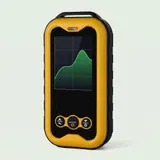
Geiger Counter Shop sells one pocket Geiger counter, and everything above applies to it. It uses a glass Geiger-Muller tube, a J321 type as listed by the supplier, and counts beta, gamma and X-rays, not alpha. A 2.4-inch colour screen shows real-time and average dose rate in µSv/h, CPM or CPS, cumulative dose and a dose-rate trend graph. Two alarms (dose rate and dose) have adjustable thresholds and sound, flash or vibrate. Data such as the cumulative dose is kept after power off.
The built-in 1,800 mAh lithium-ion battery charges over USB-C and is not user-replaceable: the manufacturer states 30 days or more in long-life mode, while an independent test found about 5 days in normal use. There is no Bluetooth and no app. UK orders ship free from a UK warehouse, with no customs step: 1 to 2 working days to prepare, then 2 to 5 working days in transit, as an indication rather than a guaranteed date. The box holds a USB-C cable and manual, but no charger and no radioactive test source.
Frequently asked questions
Why does a Geiger counter click?
Every click is one pulse from the tube, meaning one ionising event reached its gas. The pace of the clicks follows the count rate. On the counter described here, the particle sound can be switched on or off in the settings, and the screen shows the same information as CPM or CPS.
Can a Geiger counter detect all radiation?
No. A glass-tube Geiger counter does not detect alpha radiation, and it does not measure radon concentration, which needs a radon measurement pack. It responds to beta, gamma and X-rays within the energy range its maker states. It does not detect Wi-Fi, microwaves, EMF or 5G either, because those are not what a Geiger-Muller tube counts.
Is it legal to own a Geiger counter in the UK?
Yes. Owning a consumer Geiger counter that contains no radioactive source needs no licence or permit in the United Kingdom, as in the United States. The counter only counts what reaches its tube. The one described in this guide comes with no radioactive test source, so there is nothing in the box to register or declare.
Sources
- HyperPhysics (Georgia State University), Geiger Counter
- U.S. EPA, Radiation Terms and Units
- U.S. EPA, Radiation Sources and Doses
Our guides are based on the supplier's listings and public documentation. We have not tested the counter ourselves.


