
The short answer: yes, very slightly
Every banana is a little radioactive, and so is anything else that contains potassium. The reason is an isotope called potassium-40. According to the EPA, a small fraction of all potassium is radioactive, and bananas and Brazil nuts are the best-known food examples. Reference data put potassium-40 at about 117 parts per million of natural potassium, which is 0.0117%. Its half-life is 1.248 billion years, so the amount in the potassium around us barely changes over a human lifetime. The potassium in a banana is ordinary potassium; potassium-40 simply comes along with it, in the same tiny proportion found everywhere.
So the honest answer to 'is potassium radioactive?' is: a tiny part of it is. That part is natural, it was not added, and it has nothing to do with how a banana was grown, shipped or stored. The rest of this guide looks at what the EPA actually says about the dose, and how people use the banana as a way to picture very small numbers.
The banana number, according to the EPA
The EPA page on natural radioactivity in food gives two figures worth remembering. First, eating one banana gives a total dose of 0.01 mrem, which is 0.1 µSv (microsievert). Second, it would take about 100 bananas to equal the dose a person in the United States receives each day from natural background radiation. That background comes mostly from minerals in the ground and water and from cosmic radiation, and the EPA notes that it varies from place to place and rises with altitude: Denver receives more cosmic radiation than places at sea level.
The EPA describes the amounts in food as very small. That is the agency's wording, quoted here as context. This article does not turn it into a rule about how much fruit anyone should eat: it is a units explainer, and the banana is only a convenient yardstick for very small doses. Background also differs between countries, which is one reason the US and UK yearly averages in the table below are not the same.
| Item or event | Dose | Source |
|---|---|---|
| Eating one banana | 0.1 µSv (0.01 mrem) | EPA |
| About 100 bananas | About one day of US natural background dose | EPA |
| Transatlantic flight | 0.08 mSv (80 µSv) | UKHSA |
| Frankfurt to New York return flight | About 120 µSv | BfS |
| US annual average | 6.2 mSv (620 mrem) | EPA |
| UK annual average | About 2.6 mSv | UKHSA |
The banana equivalent dose as a yardstick
The 'banana equivalent dose' is an informal way to picture tiny doses by counting them in bananas, using the EPA figure of 0.1 µSv per banana. It is not an official unit. Set next to official figures, the arithmetic is simple. UKHSA gives 0.08 mSv for a transatlantic flight: 0.08 mSv is 80 µSv, and 80 divided by 0.1 is 800 banana doses. Germany's BfS gives about 120 µSv for a Frankfurt to New York return, which is about 1,200. The US annual average of 6.2 mSv (EPA) is 6,200 µSv, or 62,000; the UK average of about 2.6 mSv (UKHSA) is 2,600 µSv, or 26,000.
Two units systems appear in these sources. The EPA publishes both sieverts and rem, and the conversions below are the EPA's. Effective dose is a calculated estimate: the EPA notes that it does not predict an effect on a particular person, so these comparisons describe size only. Keep the prefixes straight as well: one millisievert is a thousand microsieverts, and one sievert is a thousand millisieverts.
- 1 Sv = 100 rem
- 1 mSv = 1,000 µSv = 100 mrem
- 1 µSv = 0.1 mrem
- US annual average: 6.2 mSv = 620 mrem (EPA, citing the NCRP)
Other everyday sources of potassium-40, and a little more
Bananas are famous, not unusual. The Society for Radiological Protection, a UK body, points out that anything containing potassium contains traces of potassium-40. Brazil nuts are the other classic food example: the EPA says they hold potassium and also a little radium taken up from the soil. The SRP also mentions salt substitutes made with potassium chloride, noting that they give a small rise that can be measured. The same SRP article describes uranium and thorium traces in rocks and soils across the UK, in places at levels that make a Geiger counter click.
None of this is a list of things to avoid or to seek out. It shows that natural radioactivity is spread thinly through ordinary materials, which is exactly why every counter shows a background reading before it is pointed at anything in particular. It also explains why a reading only means something next to the background measured in the same place, with the same counter, since background varies by location and CPM vary by tube.
Can a Geiger counter see a banana?
No published source says a pocket counter can separate one banana from background, and none says it cannot, so this guide promises neither. What is known is the size of the background itself. One independent test of a pocket counter with a glass J321-type tube recorded about 20 counts per minute (CPM) at background. Background counts arrive at random, so the number wanders from minute to minute, and the tester noted that readings take time to settle. A very small extra from a nearby object is hard to tell apart from that natural wandering. CPM also depend on the tube, so they cannot be compared between different counters.
A Geiger counter is never a food test. It does not tell you anything about a food, a drink or a meal, and it is not a calibrated instrument or protective equipment. Its readings are indicative. If you ever see an unusually high or persistent reading, move away, do not handle the object and contact your state radiation control program or the EPA (911 in an emergency).
Natural radioactivity is not food irradiation
Two ideas are often mixed up. The potassium-40 in a banana is natural: it is part of the potassium the plant took up. Food irradiation is a separate process applied to some foods, and the EPA states plainly that it does not make food radioactive. So a banana is slightly radioactive whether or not it was ever irradiated, and irradiation does not add to that. Keeping the two ideas apart avoids a lot of confused and muddled headlines about 'radioactive food'.
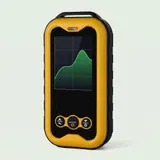
If you want to watch natural background yourself, a pocket counter shows it as dose rate in µSv/h and as CPM. Geiger Counter Shop sells one: a yellow pocket counter with a glass GM tube (J321 type as listed by the supplier), a 2.4-inch color screen, µSv/h and CPM, a trend graph, adjustable alarms and a 1,800 mAh USB-C battery, shipped free from stock in the US or UK. It detects beta, gamma and X-rays, not alpha particles, and it does not test food, radon, EMF or 5G.
Frequently asked questions
Why do bananas give off radiation at all?
Because they contain potassium. Natural potassium always includes a tiny share of potassium-40, about 117 parts per million, and that isotope decays very slowly, with a half-life of 1.248 billion years. The banana does not make it or collect anything unusual; it simply carries the same proportion found in all potassium, in soil, in other foods and in people.
Where does the phrase banana equivalent dose come from, and is it official?
It is an informal comparison, not a unit used by the EPA, UKHSA or other agencies. People use it to make microsieverts easier to picture, based on the EPA figure of 0.1 µSv for eating one banana. For real figures, quote the agencies directly in µSv, mSv or mrem, as in the table above.
Will a Geiger counter click near a bunch of bananas?
It will click near almost anything, because it counts background radiation all the time: about 20 CPM on a glass J321-type tube in one independent test. No published source says whether a pocket counter can tell a bunch of bananas apart from that background, so we make no promise either way. Treat any reading as indicative, and never as a food test.
Sources
- U.S. EPA, Natural Radioactivity in Food
- Wikipedia, Potassium-40
- Society for Radiological Protection (SRP), Our Radioactive Home
- U.S. EPA, Radiation Terms and Units
- UK Health Security Agency (UKHSA), Ionising radiation: dose comparisons
- German Federal Office for Radiation Protection (BfS), Cosmic radiation during flights
Our guides are based on the supplier's listings and public documentation. We have not tested the counter ourselves.


