
The short answer: your phone has no Geiger tube
A Geiger counter is built around a Geiger-Muller tube: a thin wire in the middle of a gas-filled cylinder held at high voltage. When a ray or particle ionizes a few gas molecules, it sets off an avalanche of electrons, which produces a pulse of current, and the device turns each pulse into a click and a count (this is how Georgia State University's HyperPhysics describes it). Your phone has cameras, microphones, a compass and motion sensors, but nothing like that tube. So no app can turn it into a Geiger counter. What some apps do instead is borrow the camera's image sensor, which was designed for light, and look for traces left by radiation passing through it.
That approach is an interesting experiment, and it may react to a strong source held very close. It is not a measurement you can lean on. Phone makers do not design, test or specify their camera sensors for radiation, an app cannot know exactly how your sensor responds, and two phones running the same app can disagree. Treat any number such an app shows as a curiosity, not as a dose rate.
How camera-sensor apps work, and why the results are rough
A camera sensor is a grid of millions of tiny light-sensitive pixels. When an energetic ray or particle passes through one of them, it can free a small burst of charge, and that pixel lights up for a single frame as a bright dot, even in total darkness. Camera-based apps rely on this effect. You cover the lens completely, usually with opaque tape, so that no light reaches the sensor. The app then watches the black image, counts the stray dots and converts that count into a figure, using its own estimate of how a phone sensor responds.
The limits come from the hardware. The sensor is tiny compared with a Geiger tube, so it catches few events and needs long runs before the number settles. Any light leak adds false dots. Heat and electronic noise create specks of their own, and the conversion stays a guess unless the response of that exact phone has been worked out against a known source. That is why these apps give rough, variable results.
| Device | What it senses | What it can tell you |
|---|---|---|
| Phone with a camera-sensor app | Bright dots on a covered image sensor | A rough sign that a strong source is close, not a dose rate |
| Watch or gadget without a GM tube | Usually electromagnetic fields | Field strength near wiring or radios, nothing about radioactivity |
| 3-in-1 EMF meter sold as a radiation detector | Electric and magnetic fields, radio signals | EMF levels only; it is not a Geiger counter |
| Pocket counter with a glass GM tube | Beta, gamma and X-rays (no alpha) | Indicative dose rate in µSv/h, CPM, cumulative dose and trends |
| Radon test kit | Radon gas in indoor air | A radon concentration, which a Geiger counter does not measure |
Radiation detector watches and gadgets: look for the tube
A search for a geiger counter watch turns up very different products under the same words. A gadget that really counts ionizing radiation names its detector in the specifications: a Geiger-Muller tube, or GM tube, with readings in µSv/h and CPM. Many others sold as radiation detectors only read electromagnetic fields from wiring, chargers and radio transmitters. In public listings checked on September 28, 2026, the 3-in-1 detectors marketed as radiation detectors ran roughly $13 to $28, and most of them were EMF meters rather than Geiger counters.
Before you buy, read the specifications rather than the product name. Look for the words Geiger-Muller tube, the types of radiation listed (beta, gamma, X-rays) and readings in µSv/h and CPM. Units such as mG, µT or V/m, or claims about Wi-Fi and 5G, point to an EMF meter. That is a different instrument answering a different question, and it says nothing about radioactivity.
EMF and 5G are not what a Geiger counter measures
Radio waves from phones, Wi-Fi routers and 5G antennas, and the low-frequency fields around wiring and appliances, are non-ionizing: they do not carry enough energy to knock electrons off atoms. A Geiger tube only counts when the gas inside it is ionized, so it responds to ionizing radiation, which for a glass tube means beta particles, gamma rays and X-rays. A Geiger counter does not detect EMF, Wi-Fi or 5G, and holding one next to a router or a phone is not a test of that signal.
The reverse is also true: an EMF meter tells you nothing about radioactivity. If your question is about radio signals, a Geiger counter is the wrong tool. If it is about radon, a gas that can build up indoors, neither device is right. The EPA points to a radon test kit, sold in hardware stores, online or through your state radon program, or to a qualified professional. A Geiger counter does not measure a radon concentration.
What a real pocket Geiger counter adds
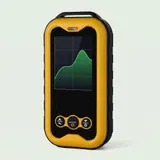
A dedicated counter starts where the phone stops: with a tube. The yellow pocket counter sold by Geiger Counter Shop uses a glass Geiger-Muller tube (J321 type, as listed by the supplier) that responds to beta, gamma and X-rays, not alpha. Its 2.4-inch color screen shows real-time and average dose rate in µSv/h, the count rate in CPM or CPS, cumulative dose in µSv and a dose-rate trend graph. Two alarms, one for dose rate and one for dose, have adjustable thresholds and can sound, flash or vibrate. The manufacturer gives a range of 0.01 µSv/h to 50 mSv/h.
It has no Bluetooth and no phone app. Its USB-C port charges the built-in 1,800 mAh battery (the manufacturer states 30 days or more in long-life mode; one independent test found about 5 days in normal use), and the manufacturer describes a data download to a PC over USB-C with its own software, which is not included. Readings are indicative: it is a consumer detector, not a calibrated measuring instrument, not personal protective equipment and not a radon test. On beta sources the µSv/h figure reads high, so watch CPM.
Quick checklist before you trust a reading
Whatever device you use, a few habits keep the numbers honest. Take a background reading first, away from the object, and give it time, since a tube reading takes a while to settle. Compare the same counter over time rather than comparing CPM between different counters, because each tube responds differently. For context, the EPA puts the average annual dose in the United States at about 6.2 mSv (620 mrem) from all sources, and notes that background varies from place to place and rises with altitude. That figure describes an average, not a limit for any single object.
If a reading is unusually high or stays high, move away from the source, do not handle the object and contact your state radiation control program or the EPA; in an emergency, call 911. With old uranium glass, uranium-glazed dinnerware or radium-dial clocks, keep items intact, never open a radium dial, do not serve food or drink in them, wash your hands after handling, and if one breaks, ask your local authority how to dispose of it.
- Does the device name a Geiger-Muller tube, or does it only mention EMF, Wi-Fi or 5G?
- Does it show µSv/h and CPM, not just a color bar or a score?
- Does it list the radiation it responds to (beta, gamma, X-rays)?
- With a camera app: is the lens fully covered and the run long enough?
- Is your question about radon? Then use a radon test kit instead.
Frequently asked questions
Is there a real Geiger counter app?
Not on its own, because the Geiger-Muller tube is hardware and a phone does not have one. An app that claims to measure radiation with nothing attached is relying on the phone's own sensors, usually the camera. Its figures are rough estimates shaped by that one sensor, the light seal and the run time, not dose rates you can rely on or compare with a counter.
Can a phone detect radiation?
Not the way a Geiger counter does. A phone has no built-in radiation sensor. A camera-based app may register hits from a strong source held against a fully covered lens, but the result depends on that phone's sensor and on how long you let it run. It works as a demonstration of the physics, not as a reading to base decisions on.
Does the counter connect to my phone?
No. The pocket counter described in this guide has no Bluetooth and no phone app, so everything appears on its own 2.4-inch screen, including the trend graph and the alarm settings. It keeps its data after power off. The manufacturer describes downloading data to a PC over USB-C with its own dose-management software, which does not come in the box.
Why does a phone app show a different number than a Geiger counter?
They use different detectors and count different things. A counter reports pulses from its tube, and even two Geiger counters with different tubes give CPM figures you cannot compare directly. A camera app estimates from dots on a sensor built for light. Follow the trend on one device over time and read any single number as indicative.
Sources
Our guides are based on the supplier's listings and public documentation. We have not tested the counter ourselves.


