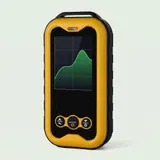
What makes a Geiger counter truly portable
Portability comes down to size, weight and power. This counter measures 5.0 x 2.6 x 1.1 in (127 x 65 x 27 mm) and weighs 5.6 oz (160 g) with its battery, small enough for a jacket pocket or a daypack side pocket. A built-in 1,800 mAh lithium-ion battery charges over USB-C, so there are no AA cells to buy or swap. The trade-off: the battery is not user-replaceable, and the box holds a USB-C cable but no wall charger, case or lanyard.
The manufacturer rates it for use from 14 to 113 °F (-10 to +45 °C). No water resistance rating is published, so keep it dry in rain or snow. Your cumulative dose, trend curves, alarm history and thresholds stay in memory after the power goes off, and the menu comes in several languages. It comes in one color, a yellow and black case that is easy to find at the bottom of a bag.
Pocket vs handheld vs pen-style counters
Listings use these words loosely. "Pocket" and "handheld" usually describe the same class: one body with the tube inside, a screen and a few buttons, used in one hand. This counter belongs there. Pen-style counters are slimmer sticks that clip to a shirt, and to fit that shape they often use a shorter Geiger tube. According to the maintainer of an open-source counter firmware, a short tube of the J614 type is less sensitive at background than a J321-type tube, the type the supplier lists for this counter.
At the other end sit survey meters with a separate probe on a cable, built for scanning surfaces rather than riding in a pocket. Consumer scintillation counters with a spectrometer, about $250 to $600 in public prices seen in September 2026, are more sensitive to gamma than a Geiger tube of this size. Be wary of cheap "3-in-1" radiation detectors, about $13 to $28: most are electromagnetic field meters, not Geiger counters.
| Type | What it suits | What to know |
|---|---|---|
| Pocket counter with screen (this one) | Everyday carry: µSv/h, CPM, graph and alarms in 5.6 oz (160 g) | No alpha; consumer Geiger counters ran about $26 to $128 |
| Pen-style counter | Slim carry clipped to a shirt | Often a shorter tube, less sensitive at background |
| Survey meter with probe | Scanning surfaces with a probe on a cable | Larger, not a pocket carry |
| Scintillation counter with spectrometer | More gamma sensitivity than a pocket Geiger tube | About $250 to $600 |
| "3-in-1" radiation detector | Mostly electromagnetic field readings | About $13 to $28; usually not a Geiger counter |
What it reads on the go
The 2.4-inch color screen shows the real-time and average dose rate in µSv/h, the count rate in CPM or CPS, and the cumulative dose in µSv. A timed dose runs up to 999 hours, and a trend graph plots the dose rate over time, as the main display if you like. The manufacturer gives a dose rate range of 0.01 µSv/h to 50 mSv/h and an energy response of 48 keV to 1.5 MeV. Above its range, the screen shows "999 MAX".
Two alarms, one on dose rate and one on dose, have adjustable thresholds and alert you by sound, flashing light or vibration, so the counter can stay in a pocket. On beta sources the µSv/h figure runs high because the tube has no beta shield, so read the CPM there. Readings are indicative and take time to settle. If a reading is unusually high or persistent, move away, do not handle the object and contact your state radiation control program or the EPA; call 911 in an emergency.
Battery life, stated both ways
Two figures exist, and both matter. The manufacturer states a power draw under 15 mW and 30 days or more of use in the long-life mode. An independent test reports about 5 days in normal use. The gap comes from the setting: the counter has a normal mode and a long-life mode, plus adjustable backlight time and brightness and an optional click for each particle. Plan around the shorter figure for a trip and treat the longer one as what the long-life mode is designed for.
Charging is simple: plug the supplied USB-C cable into a computer port or a 5 V USB charger you already own, since no wall charger is in the box. Treat it like any lithium-ion device: do not heat or puncture it, and do not leave it charging unattended. It is not a toy. Before a long trip, top it up and consider switching to the long-life mode.
Taking it on a flight
The battery is 3.7 V and 1,800 mAh, which works out to about 6.7 Wh. FAA guidance on lithium batteries limits lithium-ion batteries in personal devices to 100 Wh, so this battery sits well under that figure. Airline rules can add their own conditions, so check your airline before you fly. Owning a consumer Geiger counter without a radioactive source requires no license or permit in the United States or the United Kingdom, and at 5.6 oz (160 g) it adds little to a carry-on.
Expect higher readings at cruising altitude. The EPA notes that cosmic radiation increases with altitude, which is why Denver receives more than Miami. For context, the UKHSA puts a transatlantic flight at about 0.08 mSv, and the EPA gives an average of 6.2 mSv a year per person in the United States. The timed dose or cumulative dose mode can log a whole trip. These figures are context, not a verdict on any reading.
What a portable counter does not measure
The glass tube picks up beta, gamma and X-rays; it does not detect alpha. It is not a radon test: the EPA points to a radon test kit or your state radon program. It does not test food or water, and it does not read electromagnetic fields, Wi-Fi or 5G. There is no Bluetooth and no phone app. The manufacturer describes a PC data download over USB-C with its own software, which is not included. It is a consumer detector, not a calibrated measuring instrument.
Uranium glass, some pre-1973 uranium-glazed dinnerware and old radium watch dials can make the counter react when held close, according to the EPA. Keep such objects intact, never take a radium dial apart, do not serve food or drinks in them and wash your hands after handling them. If one breaks, ask your local authority how to dispose of it rather than sweeping it into the trash.
Frequently asked questions
Can I compare my CPM with another counter or the EPA RadNet map?
Not number for number. CPM depends on the tube, so two different counters give different counts in the same place. EPA RadNet stations measure gamma in the air with different units, height and calibration. Compare trends instead, with your own counter's trend graph.
Does it come with a radioactive source to check that it works?
No. The box holds the counter with its built-in battery, a USB-C cable, the user manual, and the manufacturer's inspection slip and warranty card, nothing else. At background, one independent test measured about 20 CPM with this tube type, so a steady trickle of counts in an ordinary room is expected.
Why does the dose rate jump near some rocks or granite?
Granite can hold traces of natural radioactive elements that give off some beta and gamma, varying from stone to stone, the EPA says. Radiation falls off quickly with distance, so the reading drops as you step back. Treat the number as indicative; radon from the ground is a far more common topic, and this counter does not test it.
How is it delivered and can I return it?
Geiger Counter Shop ships it free from its US stock for US orders: prepared in 1 to 2 business days, then delivered in 3 to 6 business days (indicative), with tracking by email and no customs step. You have 30 days after delivery to change your mind, with a refund within 14 days of receiving the return.
Sources
- FAA PackSafe, Lithium Batteries
- UK Health Security Agency (UKHSA), Ionising radiation: dose comparisons
- U.S. EPA, Cosmic Radiation
Our guides are based on the supplier's listings and public documentation. We have not tested the counter ourselves.