
What radon is and how it is measured
Radon is a naturally occurring radioactive gas. The EPA notes that radon coming from the soil is a far more common household issue than radiation from materials inside the home, such as a granite countertop. It is a concentration in the air, and official programs measure it as an average over a set period of days or months rather than as a quick spot reading. In the United States, results are reported in picocuries per liter of air (pCi/L). In the United Kingdom, they are reported in becquerels per cubic meter (Bq/m3). The EPA defines one becquerel as one radioactive decay per second; the picocurie is a very small unit on the older curie scale.
The time frame is the core of the method: a radon test stays in place for its measurement period, and the result is one number describing that air over that time. For wider context, UKHSA puts the average radiation dose in the UK at about 2.6 mSv per year, of which about 1.3 mSv comes from radon. Those are population averages quoted by UKHSA, not a limit and not a verdict on any particular house, so they cannot replace a test of your own home.
Why a Geiger counter cannot give you a radon number
A Geiger-Muller tube is, in the words of HyperPhysics at Georgia State University, a wire at the center of a cylinder held at high voltage. When a particle ionizes a few gas molecules inside, it sets off an avalanche of electrons and a pulse of current, which the device turns into a click. A pocket counter adds up those pulses as counts per minute (CPM) and converts them into an indicative dose rate in µSv/h. It responds to beta, gamma and X-ray events that reach the tube close to the device. It does not draw in air, it does not average a volume of gas over days, and it never reports pCi/L or Bq/m3.
There is a second, more basic reason. Radon decays by emitting alpha particles, and those alpha decays do not reach the inside of a glass tube. A glass Geiger-Muller tube does not detect alpha at all. So even in a room where a radon test would come back high, the counter has no way to turn that gas into the concentration a radon test reports. A number on its screen in a basement is a local count near the tube, not a radon result, and it should never be read as one.
| Question | Handheld Geiger counter | Radon test kit or measurement pack |
|---|---|---|
| What does it measure? | Counts (CPM) and an indicative dose rate (µSv/h) from beta, gamma and X-ray events near the tube | The average radon concentration in the air of a room |
| What unit is the result in? | CPM, µSv/h and µSv | pCi/L in the US, Bq/m3 in the UK |
| How long does it take? | A live reading that needs time to settle | Days to months, as set by the test |
| Can it tell me my home's radon level? | No | Yes, that is its purpose |
| Does it respond to alpha? | No, the glass tube does not detect alpha | Follow the kit's instructions and the official program |
| Where do I get guidance? | The device's manual; readings are indicative | EPA and your state radon program (US), UKHSA at ukradon.org (UK) |
What a Geiger counter may still show
A counter can show a change in readings near some objects and materials. The EPA explains that uranium glass (yellow-green, and it glows green under a UV lamp), some dinnerware made before 1973 with a uranium glaze, and old self-luminous watch or clock dials that may contain radium can make a Geiger counter react when it is held close. Granite can give off a little beta and gamma radiation that varies from stone to stone and drops quickly with distance. Background levels also vary from place to place and rise with altitude. In one independent test, a J321-type glass tube read about 20 CPM at background. CPM figures cannot be compared between different counters, and on beta sources the µSv/h figure runs high because the tube has no beta shield, so read CPM there.
What the counter says nothing about is the air in the room. Its readings are indicative, and it is not a calibrated measuring instrument, not protective equipment and not a radon test. If you see an unusually high or persistent reading, move away from the source, do not handle the object and contact your state radiation control program or the EPA (in the UK, UKHSA or your local authority). In an emergency, call 911 in the US or 999 in the UK.
- Keep old objects intact, and never take apart a radium dial.
- Do not serve food or drink in old uranium-glazed dinnerware or uranium glass.
- Wash your hands after handling such objects.
- If one breaks, ask your local authority how to dispose of it.
How to test a home for radon
In the United States, the EPA's radon testing guidance points to radon test kits, which you can find at hardware stores, online or through your state radon program, or to a radon measurement professional. The kit is the tool built for the question you are asking: it stays in place for the period its instructions give, then reports an average concentration in pCi/L. Your state radon program is also the place to ask where and how to place a test, and what to do with the result once you have it.
In the United Kingdom, UKHSA runs UK Radon at ukradon.org. Radon there is measured with a radon measurement pack, reported in Bq/m3, and UKHSA publishes maps of radon Affected Areas that show where testing matters most. According to UK Radon, if a home's level turns out to be high, fairly simple building work can reduce it. In both countries, the official program, not a handheld counter, is where the decision about your home should start.
Granite countertops: what the EPA says
According to the EPA, granite can contain traces of naturally occurring radioactive elements that give off some beta and gamma radiation, and the amount varies from one slab to another. That radiation drops quickly with distance from the stone. The EPA adds that measuring a countertop precisely requires calibrated instruments and a trained user. A pocket counter held against a counter may show counts above your usual background, or it may not, and neither result is a precise measurement of the stone.
The EPA's larger point is about priorities: radon coming from the soil is the far more common issue in homes. A countertop reading, high or low, tells you nothing about the radon concentration in your kitchen or basement air. If radon is your concern, the answer is the same as everywhere else in this guide: use a radon test kit or measurement pack and follow your official program.
What to do next
Start with the official source for your country. In the US, read the EPA radon testing page and contact your state radon program, then run a radon test kit as instructed. In the UK, check the radon Affected Areas maps on ukradon.org and order a radon measurement pack through UK Radon. Keep any Geiger counter readings separate from that process: they are a different measurement, in different units, of a different thing.
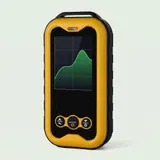
A Geiger counter is still a useful tool for what it actually does: watching background counts and trends, and looking at readings near objects you already own. Geiger Counter Shop sells one pocket Geiger counter with a glass GM tube (J321 type, as listed by the supplier), a 2.4-inch color screen, µSv/h and CPM, a dose-rate trend graph, adjustable alarms and a 1,800 mAh USB-C battery, shipped free from stock in the US or the UK. It is not a radon test and is never sold as one.
Frequently asked questions
Will a Geiger counter pick up radon in my basement?
It will not give you a radon result. The counter may show its usual background counts in a basement, but it cannot turn the gas in the air into the pCi/L or Bq/m3 figure that decides whether a home needs attention. For your basement, place a radon test kit (US) or a radon measurement pack (UK) as its instructions describe and read the reported average.
Is there a radon mode on a pocket Geiger counter?
No. The menu offers dose rate, count rate, cumulative dose, a trend graph and alarms, but no setting changes what the tube can count. A radon program asks for an average air concentration over days or months, which no tube reading provides.
Which radon test should I buy?
Let the official program guide you rather than a seller. In the US, the EPA radon testing page lists where to find test kits (hardware stores, online, your state radon program) and how to find a measurement professional. In the UK, order a radon measurement pack through UKHSA at ukradon.org, starting with the radon Affected Areas maps to see where testing matters most.
My counter reads higher in the basement than upstairs. Is that radon?
You cannot tell from the counter. Readings vary from place to place, take time to settle, and a glass tube does not see radon's alpha decays. Treat the number as indicative only. If it is unusually high or persistent, move away and contact your state radiation control program or the EPA (UKHSA or your local authority in the UK), and test the air with a radon kit.
Sources
- U.S. EPA, Find a Radon Test Kit or Measurement and Mitigation Professional
- UKHSA, UK Radon
- U.S. EPA, Granite Countertops and Radiation
Our guides are based on the supplier's listings and public documentation. We have not tested the counter ourselves.


