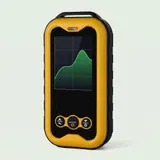

The units on the screen: CPM, CPS, µSv/h and µSv
Every click you hear is one pulse from the Geiger-Muller tube. HyperPhysics (Georgia State University) describes the tube as a wire in the center of a gas-filled cylinder held at high voltage: when a particle ionizes a few gas molecules, it sets off an avalanche of electrons and a pulse of current, and the counter turns each pulse into a click. CPM, counts per minute, and CPS, counts per second, are that tally and nothing more. They are the rawest numbers on the screen, because nothing has been converted yet. That makes them the most useful numbers when the dose-rate estimate is known to mislead, for example on a beta source.
µSv/h, microsieverts per hour, is a dose rate. The counter takes its count rate and applies a conversion chosen by the manufacturer, so it is an estimate, not a direct measurement of what a person receives. Many counters show both a real-time dose rate and an average dose rate. µSv, without the "per hour", is cumulative dose: the dose rate added up over a period. In a cumulative dose mode with a timer, that period is something you set and reset yourself.
Sievert, rem, gray, becquerel and curie: what each one measures
The EPA's Radiation Terms and Units page sorts the units by the question they answer. How much radioactive material is there? That is activity, in becquerels (Bq, one decay per second) or curies (Ci, often written as picocuries, pCi). How much energy did a material absorb? That is absorbed dose, in gray (Gy) or rad. How is exposure expressed as one figure for the whole body? That is effective dose, in sieverts (Sv) or rem. US sources often use rem and millirem, while UK sources use sieverts. The EPA adds that effective dose is a calculated estimate: it does not predict an effect on any one person.
The conversions are decimal steps. 1 Sv equals 100 rem, 1 mSv equals 100 mrem, and 1 µSv equals 0.1 mrem. So a reading of 0.10 µSv/h is 0.01 mrem per hour. A pocket Geiger counter works in sieverts because it estimates dose rate. It does not display becquerels or curies, which describe how much radioactive material a source contains, and it does not display gray.
| Unit | What it measures | Where you see it |
|---|---|---|
| CPM or CPS | Pulses counted by the tube per minute or per second; specific to that tube | Counter screen, count rate |
| µSv/h | Estimated dose rate, real time or averaged | Counter screen, main reading and trend graph |
| µSv | Cumulative dose over a period you set | Counter cumulative dose mode and timed dose |
| mSv or mrem | Effective dose over long periods (1 mSv = 100 mrem) | UKHSA and EPA annual averages |
| Gray (Gy) or rad | Absorbed dose: energy absorbed by a material | EPA units page, technical documents |
| Becquerel (Bq) or curie (Ci, pCi) | Activity: decays per second in a source | EPA units page, descriptions of sources |
Why CPM belongs to the tube, not to the room
CPM depends on the tube that does the counting. Two working counters placed side by side on the same shelf can show very different CPM, simply because their tubes catch a different share of the radiation passing through. The maintainer of an open-source counter firmware notes, for example, that short tubes of the J614 type pick up less background than a J321-type tube. One independent test of a counter with a J321-type glass tube states the rule plainly: CPM cannot be compared between two different counters. A CPM figure from a stranger's video or forum post tells you little unless the tube is the same. Compare your own CPM against your own earlier CPM instead.
µSv/h is the manufacturer's attempt to turn those counts into a dose-rate estimate, and it has limits of its own. A glass tube without a beta shield overstates the µSv/h figure on a beta source, and the independent tester advises reading CPM in that case. The practical rule: for beta-emitting objects, track CPM on the same counter over time; for general background, note both the CPM and the average µSv/h.
What background radiation looks like on a Geiger counter
Background radiation is always there. The EPA's Radiation Sources and Doses page explains that it comes mostly from minerals in the ground, from water and from cosmic radiation, that it varies from place to place, and that it rises with altitude: Denver receives more cosmic radiation than places at sea level. On a counter, background is a slow, irregular flicker of clicks. In one independent test, a J321-type glass tube read about 20 CPM at background. Treat that as one data point from one location, not a target. Your number at home, at work or in the mountains can differ, and none of those numbers is a verdict on its own.
Annual averages give wider context. They are totals over a whole year, in millisieverts, while your screen shows microsieverts per hour. The EPA's RadNet network, with 140 air monitoring stations across the 50 states, publishes near real-time gamma readings on a public dashboard; its units, height and calibration differ from a pocket counter, so compare trends, not figures. The averages below are quoted as their agencies publish them, as context and not as a line on your screen.
- UK average exposure: about 2.6 mSv per year (UKHSA, Ionising radiation: dose comparisons)
- US average: 6.2 mSv (620 mrem) per person per year, according to the NCRP (EPA, Radiation Sources and Doses)
- One transatlantic flight: about 0.08 mSv (UKHSA)
- UK average annual dose from radon: 1.3 mSv (UKHSA); radon itself is measured with a radon test kit, not a Geiger counter
How to read a Geiger counter: instant versus average
The count never sits still, because the clicks arrive irregularly. The real-time dose rate reacts to every short burst, while the average smooths them out. Switch the counter on, set it down and give it a few minutes before you read anything. The independent test also noted that a reading takes time to settle on a source, and time to fall back to background after a more active object, so a figure seen in the first seconds is rarely the one to keep. A trend graph helps: a flat, noisy line is background, while a step that holds is worth a second look.
To compare two things, compare like with like. Take a background average in the same room first. Then hold the counter at the same distance from each object for the same length of time, and compare averages, not peaks. Distance matters: the EPA notes that radiation from granite drops quickly with distance. Geiger Counter Shop sells one pocket counter built for this kind of reading: a glass GM tube (J321 type, as listed by the supplier) for beta, gamma and X-rays, a 2.4-inch color screen with real-time and average µSv/h, CPM, a trend graph, alarms and a 1,800 mAh USB-C battery, shipped free from stock in the US or UK.
When a reading is unusually high or persistent
A consumer Geiger counter gives general information only. It is not a calibrated measuring instrument, not personal protective equipment and not a radon test, and its readings are indicative. If you measure a level that is unusually high compared with your own background, or one that stays high after you have waited and checked again, stop investigating. Move away from the source and do not handle the object. In the US, contact your state radiation control program or the EPA, and call 911 in an emergency. In the UK, contact the UK Health Security Agency or your local authority, and call 999 in an emergency.
Old objects are one reason a counter can react at home. The EPA's Radioactivity in Antiques page notes that uranium glass (vaseline or canary glass, which glows green under UV light), some orange-red dinnerware glazed with uranium before 1973 and self-luminous radium dials on watches and clocks can make a Geiger counter react when held close, and that intact pieces in good condition generally do not pose a problem. Keep them intact, never take apart a radium dial, do not serve food or drink in them, and wash your hands after handling. If one breaks, ask your local authority how to dispose of it.
- No alpha: a glass tube sees beta, gamma and X-rays only.
- Not a radon test: use a radon test kit (EPA) or a radon measurement pack (UKHSA).
- Not a meter for EMF, Wi-Fi or 5G, and not a food or water test.
Frequently asked questions
What is a normal reading on a Geiger counter?
There is no single number. Background depends on where you are and rises with altitude (EPA), and CPM depends on the tube: one independent test recorded about 20 CPM on a J321-type glass tube. For context, UKHSA gives about 2.6 mSv a year in the UK and the EPA 6.2 mSv in the US. Learn your own background average and watch for changes from it.
How many CPM is 1 µSv/h?
It depends on the tube and on the energy of the radiation, so there is no universal factor. For this counter, the manufacturer lists a sensitivity of more than 1 CPS per µSv/h, which is a minimum, not a conversion. Do not convert by hand: read the µSv/h the counter computes, and use CPM to compare readings on the same counter, especially on beta sources.
Why does my reading jump around?
Clicks arrive irregularly, so the real-time figure moves with every short burst while the average moves slowly. At background, a few clicks more or less shift the instant reading noticeably. Wait a few minutes, read the average and look at the trend graph. A reading that stays unusually high after you check again is the one to act on: move away and contact the authority.
Can a Geiger counter check a home for radon?
No. A Geiger counter is not a radon test and gives no radon concentration. The EPA recommends a radon test kit, sold in home improvement stores, online or through your state radon program, or a test by a professional. In the UK, UKHSA offers a radon measurement pack, and its maps of radon Affected Areas show where to test.
Sources
- U.S. EPA, Radiation Terms and Units
- UK Health Security Agency (UKHSA), Ionising radiation: dose comparisons
- U.S. EPA, Radiation Sources and Doses
- U.S. EPA, Cosmic Radiation
Our guides are based on the supplier's listings and public documentation. We have not tested the counter ourselves.


