
The short answer: a flight adds a small, measurable dose
Part of everyone's background radiation comes from space. The EPA explains that this cosmic radiation increases the higher you are in the atmosphere, which is why Denver receives more of it than Miami. A plane at cruising altitude sits well above both cities, with much less air overhead to absorb the particles, so the dose adds up faster than it does on the ground. Two official figures give the scale. The UK Health Security Agency (UKHSA) lists a transatlantic flight at 0.08 mSv. Germany's Federal Office for Radiation Protection (BfS) gives an average of about 120 µSv for a return trip between Frankfurt and New York.
Written in the same unit, those two figures are close: 0.08 mSv is 80 µSv, and a return trip is roughly two crossings. In the US unit, 80 µSv is 8 mrem and 120 µSv is 12 mrem. These are average estimates published by radiation agencies, not readings from a pocket counter, and the rest of this guide explains why the two should not be confused.
What changes the dose from one flight to the next
The BfS names four factors. The first is duration: the longer you stay at altitude, the more dose you add, so a long-haul flight counts for more than a short hop. The second is altitude itself. Radiation at flight level is made of very high-energy particles from space and the particles they create when they hit the atmosphere, and it falls as you descend because the air below is denser. The third is the route. Earth's magnetic field deflects part of the incoming particles; it shields the most at the equator and the least near the magnetic poles, so a route that passes close to the poles picks up more than one that stays near the equator.
The fourth factor is the Sun. Solar activity follows a cycle of about 11 years, and according to the BfS, the stronger that activity, the weaker the cosmic radiation reaching the atmosphere. The same route flown at the same height can therefore give a slightly different dose from one year to another. This is also why a single published figure for a route is an average, not a promise for your particular flight.
- Duration: more hours at altitude, more dose.
- Altitude: higher means less air overhead and a higher rate.
- Route: the least shielding near the magnetic poles, the most at the equator.
- Solar activity: a stronger Sun means weaker cosmic radiation, on a cycle of about 11 years.
| Flight or reference | Dose | Source |
|---|---|---|
| Transatlantic flight | 0.08 mSv (80 µSv, 8 mrem) | UKHSA, Ionising radiation: dose comparisons |
| Frankfurt to New York and back | About 120 µSv (12 mrem), average | BfS, Cosmic radiation during flights |
| Average annual dose, United States | 6.2 mSv (620 mrem) | EPA, Radiation Sources and Doses (NCRP data) |
| Average annual dose, United Kingdom | About 2.6 mSv (260 mrem) | UKHSA, Ionising radiation: dose comparisons |
| Share of the US annual dose from cosmic radiation | About 5 % | EPA, Cosmic Radiation |
| Eating one banana, for scale | 0.1 µSv (0.01 mrem) | EPA, Natural Radioactivity in Food |
The numbers in context: µSv, mSv and mrem
Flight doses appear in three units, and the EPA's Radiation Terms and Units page links them. The sievert (Sv) is the unit of effective dose; one millisievert (mSv) is a thousandth of it and one microsievert (µSv) a millionth. The older US unit is the rem: 1 Sv equals 100 rem, 1 mSv equals 100 mrem, and 1 µSv equals 0.1 mrem. The EPA also notes that effective dose is a calculated estimate and does not predict an effect on a given person.
To place a flight among other figures, the EPA gives an average annual dose per person in the United States of 6.2 mSv (620 mrem), based on NCRP data, and the UKHSA gives about 2.6 mSv a year for the UK. The EPA adds that about 5 % of the US annual dose comes from cosmic radiation. These are references published with their source, quoted here for scale only.
What a pocket Geiger counter shows on board
Switched on during a flight, a pocket counter will usually show its reading rise above what it showed at ground level as the plane climbs, then fall again on the way down. That matches what the EPA and the BfS describe. No official source we rely on gives an in-flight dose rate in µSv/h for a pocket counter, so we give no figure here. The reason for caution is technical: the µSv/h figure is a conversion the manufacturer sets for gamma rays, with an energy response of 48 keV to 1.5 MeV (manufacturer figures), while the radiation at flight level is a mix of very high-energy particles. The number on screen is indicative, not the dose you actually receive.
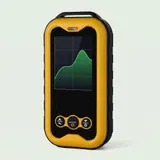
What stays meaningful is the change. Watch the dose-rate trend graph and the count rate (CPM) as the plane climbs, cruises and descends. CPM is the raw count of the tube, so it only compares with itself on the same counter. The two alarms, for dose rate and dose, have adjustable thresholds and can use sound, a flashing light or vibration: raise the threshold or switch to vibration before takeoff so the alarm does not go off for the whole flight.
- Watch the trend graph rather than a single µSv/h value.
- Compare CPM with your own ground reading, never with another counter.
- Set the alarm thresholds, or vibration mode, before boarding.
- The cumulative dose mode can run for the trip, as an indicative total.
Taking the counter through the airport
The rules that matter here are the battery rules. The counter runs on a built-in 1,800 mAh lithium-ion battery at 3.7 V, which works out to about 6.7 Wh. The FAA's PackSafe guidance limits lithium-ion batteries in personal devices to 100 Wh, so this battery is far below that line. The battery is not user-replaceable, so it travels inside the counter. Keep the counter in your carry-on bag, in the cabin, and check your airline's own rules before you fly, because airlines can set their own conditions. Owning a consumer Geiger counter with no radioactive source requires no license.
The counter measures 5.0 x 2.6 x 1.1 in (127 x 65 x 27 mm) and weighs 5.6 oz (160 g), so it fits a jacket pocket or a seat-back pouch. It is rated to operate from 14 to 113 °F (-10 to 45 °C, manufacturer figures) and has no published water resistance rating, so keep drinks away from it on the tray table. It charges over USB-C, and the box contains a cable but no wall charger.
What the counter is not
A pocket Geiger counter is a consumer radiation detector for general information. It is not a dosimeter of record, not a calibrated measuring instrument and not personal protective equipment, and its flight reading is not your official dose. Its glass Geiger-Muller tube, a J321 type as listed by the supplier, responds to beta, gamma and X-rays and does not detect alpha particles. It is not a radon test, cannot check food or water, and does not detect EMF, Wi-Fi or 5G. Readings on the ground follow the same rule: if you ever measure an unusually high or persistent level near an object, move away, do not handle it and contact your state radiation control program or the EPA, or call 911 in an emergency.
For a traveler, it is a way to watch a known effect happen: the trend line climbing after takeoff and settling again after landing. Geiger Counter Shop sells one pocket Geiger counter with a glass GM tube (J321 type as listed by the supplier), a 2.4-inch color screen, µSv/h and CPM, a trend graph, alarms and a USB-C battery, shipped free from stock in the US or the UK.
Frequently asked questions
How much radiation does one flight add?
It depends on the flight. Official averages give the scale: 0.08 mSv (80 µSv) for a transatlantic flight according to the UKHSA, and about 120 µSv for a Frankfurt to New York round trip according to the BfS. A longer flight, a higher cruising altitude or a route closer to the magnetic poles adds more; strong solar activity lowers it slightly.
Is it allowed to bring a Geiger counter in my carry-on?
The point to check is the battery. This counter's built-in lithium-ion battery is about 6.7 Wh, and the FAA's PackSafe guidance allows up to 100 Wh for batteries in personal devices. Pack it in your cabin bag and read your airline's own rules before the trip. No license is needed to own a consumer counter that contains no radioactive source.
Why is my counter's reading higher in the air than at home?
Because there is more cosmic radiation at altitude: the air above you is thinner and absorbs fewer particles, as the EPA and the BfS explain. The counter converts its counts to µSv/h with a setting made for gamma rays, while flight-level radiation is a mix of high-energy particles, so read the rise as a trend, not as your exact dose.
Can the counter give me a total dose for my trip?
It has a cumulative dose mode and a timer you can set from 0 to 999 hours, so it can add up its readings over a whole journey, and the total is kept after power off. Treat that total as indicative only: it is not a dosimeter of record, and it will not match an agency's published estimate for your route.
Sources
- UK Health Security Agency (UKHSA), Ionising radiation: dose comparisons
- German Federal Office for Radiation Protection (BfS), Cosmic radiation during flights
- U.S. EPA, Cosmic Radiation
- FAA PackSafe, Lithium Batteries
- U.S. EPA, Radiation Terms and Units
- U.S. EPA, Radiation Sources and Doses
Our guides are based on the supplier's listings and public documentation. We have not tested the counter ourselves.


