
The short answer: Hans Geiger, then Geiger and Müller
The Geiger counter was invented by Hans Geiger, in two stages. The first took place in Ernest Rutherford's laboratory at the University of Manchester: a 1908 paper by Rutherford and Geiger described an electrical method for counting alpha particles, and in 1911 Geiger built a device that counted them automatically. The second took place at Kiel, where Geiger and his doctoral student Walther Müller made the counter more efficient, more responsive, sturdier and portable. Their paper appeared in 1928, and the instrument became the Geiger-Müller counter. These dates and steps come from an APS News article of June 2012, published by the American Physical Society.
So the fair answer has one main name and one partner. Geiger is behind the 1908 to 1911 alpha counter, with Rutherford as co-author of the 1908 paper. The 1928 Geiger-Müller counter carries both names. The tube inside a pocket counter today descends from that 1928 design, which is why its full name is the Geiger-Müller tube, shortened to GM tube.
Hans Geiger before the counter: 1882 to 1908
Hans Geiger was born in 1882 and completed his PhD at Erlangen in 1906, according to APS News. His next post was at the University of Manchester, as laboratory assistant to Ernest Rutherford. That is where the counter begins. It was not designed as a consumer gadget or a field instrument. It started as a laboratory tool built for a laboratory need, which the 1908 paper names plainly: counting alpha particles by an electrical method, one particle at a time.
A quick calculation puts the dates in perspective. Geiger was in his mid-twenties when the 1908 paper appeared and in his mid-forties when the 1928 Geiger-Müller paper was published. The counter was therefore not a single moment of invention but about twenty years of work, carried from Manchester to Kiel and improved with a new collaborator, Walther Müller, along the way.
| Year | Milestone | Source |
|---|---|---|
| 1882 | Hans Geiger is born | APS News |
| 1906 | Geiger earns his PhD at Erlangen | APS News |
| 1908 | Rutherford and Geiger publish an electrical method for counting alpha particles | APS News |
| 1911 | Geiger builds a device that counts alpha particles automatically: thin wire, gas-filled tube, electron avalanche | APS News |
| 1928 | Geiger and Müller publish the Geiger-Müller tube: sturdier, portable, responsive to several kinds of ionizing radiation | APS News |
| 1945 | Geiger dies in Potsdam on September 24, aged 62 | APS News |
| Today | Pocket counters with glass GM tubes turn each ionizing event into one pulse and one count | HyperPhysics (Georgia State University) |
1908 to 1911: counting alpha particles one by one
The 1908 paper by Rutherford and Geiger described an electrical method for counting alpha particles. In 1911, APS News reports, Geiger turned that method into a device that counted them automatically. The design is simple to picture: a thin wire runs down the center of a tube filled with gas. When an alpha particle crosses the gas, it ionizes it, and the freed electrons set off an avalanche of further electrons. That avalanche is large enough to register as an electrical signal, so each particle becomes one countable event.
HyperPhysics, the physics reference of Georgia State University, describes the Geiger tube in the same terms: a wire in the center of a cylinder held at high voltage, where a particle that ionizes just a few gas molecules triggers an avalanche of electrons, and so a pulse of current. The instrument turns each pulse into a click. One ionizing event, one pulse, one click: that link was already at work in the 1911 counter.
1928: Geiger and Müller build the Geiger-Müller tube
At Kiel, Geiger worked with his doctoral student Walther Müller. According to APS News, the two made the counter more efficient, more responsive, sturdier and portable. Just as important, the new Geiger-Müller counter could detect several kinds of ionizing radiation, not only alpha particles. Their joint paper, published in 1928, is titled "Elektronenzählrohr zur Messung schwächster Aktivitäten", roughly "electron counting tube for measuring the weakest activities". The title states the goal plainly: a tube that counts electrons to measure very weak radioactivity.
Those improvements are the ones that matter to anyone holding a counter today. A sturdier, portable tube could leave the laboratory bench. A more responsive tube could follow changes as they happened. A tube that responded to more than alpha particles was useful in far more situations. The 1911 device had been a specialist alpha counter; the 1928 tube became a general detector of ionizing radiation, and it is the design a pocket counter's tube descends from.
From the 1928 tube to the pocket counter in your hand
A pocket Geiger counter still works on the principle HyperPhysics describes: one ionizing event in the gas, one avalanche, one pulse, one count. What changed is the package. Small consumer counters can use a glass Geiger-Müller tube, such as the J321 type. A glass tube of this kind responds to beta particles, gamma rays and X-rays, but it cannot detect alpha particles. That is a neat historical twist: the counter began as an alpha counter, and the glass tube in a modern pocket unit is blind to the very particles its ancestor was built to count.
The screen adds a layer Geiger never had: counts per minute (CPM) and an indicative dose rate in µSv/h. Two cautions come from the tube itself. On beta sources, a glass tube without a beta shield gives a µSv/h figure that runs high, so CPM is the better number to read. And CPM depends on the tube, so it cannot be compared between different counters. One independent test of a J321 counter recorded about 20 CPM at background.
- Not a calibrated measuring instrument and not protective equipment: readings are indicative.
- Not a radon test: the EPA points to a radon test kit, and UK readers to UKHSA and ukradon.org.
- Not a food or water test, and no response to EMF, Wi-Fi or 5G.
- No alpha: a glass tube sees beta, gamma and X-rays only.
Geiger's later years, and the name on every tube
Hans Geiger died in Potsdam on September 24, 1945, aged 62, according to APS News. His working life spans the whole story told in this guide, from Manchester to Kiel: the 1908 paper with Rutherford at Manchester, the 1911 automatic alpha counter, and the 1928 Geiger-Müller tube built with Walther Müller at Kiel. His name stayed on the instrument in everyday speech, while the full technical name, Geiger-Müller tube or GM tube, keeps Müller's place in the story.
If you use a pocket counter to follow in Geiger's footsteps, treat every reading as indicative. If you see an unusually high or persistent reading, move away from the source, do not handle the object and contact your state radiation control program or the EPA (in the UK, UKHSA or your local authority). In an emergency, call 911 (999 in the UK). Keep old objects such as uranium glass intact, and never take a radium dial apart.
Frequently asked questions
Why is it called a Geiger counter?
It carries the name of Hans Geiger, who built a device that counted alpha particles automatically in 1911, after a 1908 paper with Ernest Rutherford. The longer name, Geiger-Müller counter, adds Walther Müller, the doctoral student who worked with Geiger at Kiel on the 1928 version. The tube is often called a GM tube, and both names point to the same pair.
When was the Geiger counter invented?
Three dates matter. In 1908, Rutherford and Geiger published an electrical method for counting alpha particles. In 1911, Geiger built a device that counted them automatically, the date APS News gives for the invention. In 1928, Geiger and Walther Müller published the improved Geiger-Müller counter, the design today's GM tubes descend from.
Are Geiger counters still used?
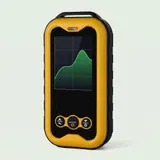
Yes. Consumer pocket counters work on the same Geiger-Müller principle: one ionizing event, one pulse, one count. Geiger Counter Shop sells one such counter, with a glass GM tube (J321 type as listed by the supplier) that sees beta, gamma and X-rays, a 2.4-inch color screen, µSv/h and CPM, a trend graph, alarms and a 1,800 mAh USB-C battery, shipped free from stock in the US or UK.
Sources
- American Physical Society, APS News: June 1911, Invention of the Geiger Counter
- HyperPhysics (Georgia State University), Geiger Counter
Our guides are based on the supplier's listings and public documentation. We have not tested the counter ourselves.


