Will a Geiger counter detect uranium glass?
Yes, if the counter is close to the glass. The EPA page Radioactivity in Antiques explains that vaseline or canary glass contains a little uranium, which gives it its yellow-green color, and that such objects can make a Geiger counter react when it is held near them. Radiation drops off quickly with distance, so a counter across the room will show little more than the room itself. Hold it against or very near the glass, let the reading settle, and compare it with a background measured first, away from the collection.
Identification is a separate job: the color and the glow under ultraviolet light are covered in our guide to checking uranium glass, old glazes and radium dials. This page is about the counter, what it adds to a UV check and where its limits are. It is the second opinion that turns a hunch from the UV lamp into a number you can note and compare.
How to check a piece: UV lamp first, then the counter
Start with a small UV lamp in a dim room: the EPA notes that uranium glass glows green under ultraviolet light, the quickest way to sort a box of glass. Then take a background reading with the counter, well away from the collection, and let the average dose rate settle. One independent test found this type of glass tube gives about 20 CPM at background, and the figure moves from minute to minute, so averages matter more than any single number. Only then bring the counter to the piece.
Keep the same distance and the same side of the counter facing the glass for every object, so results compare. Read CPM rather than µSv/h: an independent test notes the tube has no beta shield, so near beta sources the dose rate figure runs high, while CPM is the raw count of the tube. After a more active piece, let the counter fall back to background before the next one.
| Object | UV check | Counter check |
|---|---|---|
| Vaseline or canary glass (yellow-green) | Glows green under a UV lamp (EPA) | Can read above background when held close; compare CPM with background |
| Orange-red dinnerware made before 1973 | The EPA glow note is about glass, not glazes | Some have a uranium glaze and can read above background up close |
| Luminous watch or clock dial without a battery | Not the test to rely on | May contain radium; can read above background; never open it |
| Green glass with no glow under UV | No green glow | Reading in line with background fits, but proves nothing on its own |
| Broken or chipped piece | Not needed | Handle as little as possible; ask your local authority about disposal |
What the reading means, and what it does not
A reading clearly above background tells you one thing: the object gives off radiation the tube can see, at that distance. It does not tell you how much uranium the glass contains, it cannot say whether a piece is fine to use or display, and a dose rate taken against a bowl is not the dose anyone in the room receives. Readings are indicative, from a consumer detector for general information only. For context, the EPA puts the average annual dose per person in the United States at 6.2 mSv (620 mrem), and background varies from place to place and rises with altitude.
Two habits keep the numbers honest. Compare CPM only with readings from the same counter: counts depend on the tube, so another collector's figure from a different device tells you little. And if you ever see an unusually high or persistent reading, move away from the object, do not handle it, and contact your state radiation control program or the EPA. In an emergency, call 911.
Uranium-glazed dinnerware, radium dials and handling old pieces
The EPA also lists some orange-red dinnerware made before 1973, with a uranium glaze, and luminous watch and clock dials that glow without a battery, which may contain radium. The agency adds that these objects, intact and in good condition, generally are not a problem, but the counter cannot confirm that for a given piece; it only shows a reading above background. A dial deserves the most care: measure it as it is, and never open it or take it apart.
The EPA handling advice applies whatever your counter shows. A low reading does not turn an old bowl into tableware, and a high one is a reason to leave the object alone and follow the warning above. The counter is for checking what you already own or are looking at, not a reason to go looking for radioactive objects or test sources.
- Keep objects intact.
- Never take apart a radium dial.
- Do not serve food or drink in old uranium-glazed dinnerware or uranium glass, since chips can end up in what you eat.
- Wash your hands after handling.
- If a piece breaks, ask your local authority how to dispose of it.
Why a long glass tube helps with glassware
With glassware you are looking for a modest rise over background, so the number of counts matters. This counter uses a glass Geiger-Muller tube of the J321 type, as listed by the supplier. According to the maintainer of an open-source firmware for these counters, short tubes of the J614 type are less sensitive at background than a J321, so the longer tube collects more counts, and more counts make a small difference easier to see in an average. An independent test found it picks up hard beta, gamma and X-rays.
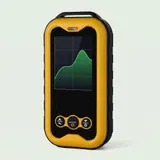
It shows real-time and average dose rate in µSv/h, count rate in CPM or CPS, cumulative dose in µSv, and a dose-rate trend graph that makes the rise near a piece easy to spot. Two alarms (dose rate and dose) have adjustable thresholds. The manufacturer gives a range of 0.01 µSv/h to 50 mSv/h and an energy response of 48 keV to 1.5 MeV. The built-in 1,800 mAh battery charges over USB-C: 30 days or more in long-life mode per the manufacturer, about 5 days in normal use in an independent test.
What this counter will not do
The glass-walled tube sees beta, gamma and X-rays only. The least penetrating kind of radiation cannot get through the glass, so a flat reading is not proof that an object emits nothing. The counter cannot test food or water, is not a radon test, and does not react to Wi-Fi, 5G or other electromagnetic fields. It is not a calibrated measuring instrument and not approved by any agency. There is no Bluetooth and no app; the manufacturer describes a PC data download over USB-C with its own software, not supplied here.
Geiger Counter Shop sells one product: this yellow pocket counter with its glass GM tube, 2.4-inch color screen, µSv/h and CPM readings, trend graph, alarms and USB-C battery. US orders ship free from stock in a US warehouse, with no customs step: prepared in 1 to 2 business days, then delivered in 3 to 6 business days (indicative, not a guaranteed date), with a tracking number by email.
Frequently asked questions
Does the counter come with a sample to test it on?
No. The box holds the counter with its built-in battery, a USB-C cable, the user manual, and the manufacturer's inspection slip and warranty card. There is no charger, case or lanyard, and never a radioactive test source. You do not need one: the tube counts natural background all the time, about 20 CPM in one independent test, so a steady trickle of counts shows it is working.
Why does the reading take a while to settle near a piece?
Counts arrive irregularly, so a single peak says little. An independent test notes that the reading takes time to stabilize on a source and to drop back to background after a more active object. Watch the average dose rate and the trend graph, wait until the line flattens, then note the figure. Moving too fast between pieces can carry the previous reading over.
Do I need a license to own a Geiger counter?
No. Owning a consumer Geiger counter that contains no radioactive source requires no license or authorization. Old radioactive objects are a separate matter: keep them intact, never take apart a radium dial, and if a piece is broken, ask your local authority how to dispose of it. If a reading is ever unusually high or persistent, contact your state radiation control program or the EPA.
Can I take the counter on a plane to a show or flea market?
The built-in lithium-ion battery is about 6.7 Wh (3.7 V, 1,800 mAh). FAA guidance on lithium batteries limits lithium-ion batteries in personal devices to 100 Wh, so it sits well under that figure. Rules still differ between carriers, so check your airline's policy before you fly, whether the counter goes in your carry-on or your checked bag.
Sources
Our guides are based on the supplier's listings and public documentation. We have not tested the counter ourselves.