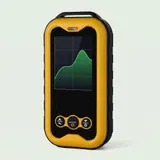
Which radiation a handheld detector actually sees
A Geiger counter counts ionizing radiation. HyperPhysics (Georgia State University) describes the tube as a wire inside a cylinder held at high voltage: a particle that ionizes a few gas molecules sets off an avalanche of electrons, a pulse of current, and the counter turns each pulse into a click and a count. This detector's glass tube responds to beta particles, gamma rays and X-rays. It does not see alpha particles, which cannot get through the glass wall. The manufacturer gives an energy response of 48 keV to 1.5 MeV and a dose rate range of 0.01 µSv/h to 50 mSv/h.
Some devices sold as radiation meters measure something else. Electromagnetic fields from power lines, Wi-Fi, microwave ovens and 5G phones are non-ionizing: a Geiger tube does not register them, so this counter tells you nothing about EMF, microwaves or 5G. It is not a radon test either: radon is measured as a concentration in air with a radon test kit, sold at hardware stores, online or through your state radon program (UK: a radon measurement pack through UKHSA). Nor can it test food or water.
Geiger counter, scintillation detector or EMF meter?
Three kinds of device share the label radiation detector, and they are not interchangeable. A pocket Geiger counter with a glass tube counts beta, gamma and X-ray events and gives an indicative dose rate. A consumer scintillation counter uses a crystal instead of a gas tube and adds a spectrometer; according to public product sheets it is more sensitive to gamma than a Geiger tube of this size, an honest step up if gamma sensitivity is your priority. The low-cost 3 in 1 meters sold as radiation detectors are mostly EMF meters and do not count ionizing radiation at all.
The price ranges in the table are orders of magnitude read on public listings on September 28, 2026, not quotes. Short-tube Geiger counters also exist; according to the maintainer of an open-source counter firmware, they are less sensitive to background than a J321-type tube. For uranium glass, granite or background radiation at home and on the road, a glass-tube Geiger counter covers beta and gamma. EMF questions need a different instrument.
| Detector type | What it senses | Typical price range |
|---|---|---|
| Pocket Geiger counter with a glass GM tube | Beta, gamma and X-rays; no alpha | About $26 to $128; most popular between $50 and $100 |
| Consumer scintillation counter with spectrometer | Gamma, more sensitively than a pocket Geiger tube | About $250 to $600 |
| 3 in 1 meter sold as a radiation detector | Mostly electromagnetic fields (EMF), not ionizing radiation | About $13 to $28 |
| Radon test kit | Radon concentration in indoor air | Not surveyed; hardware stores, online or state radon programs |
What this detector shows on its 2.4-inch screen
The color screen gives the real-time dose rate and the average dose rate in µSv/h, the count rate in CPM or CPS, and the cumulative dose in µSv. The main display shows either the numbers or the dose-rate trend graph. A timed dose mode runs for a period you set, from 0 to 999 hours, and you can check the start date of the cumulative dose. Above its range, the screen shows 999 MAX. The cumulative dose, graphs, alarm history and thresholds are kept after the power goes off.
Two alarms watch the dose rate and the dose, each with its own adjustable threshold, and they alert by sound, flashing light or vibration. The menu comes in several languages and the particle click can be switched off. The built-in 1,800 mAh lithium-ion battery charges over USB-C and is not user-replaceable. Battery life depends on use: the manufacturer states 30 days or more in long-life mode, while an independent test found about 5 days in normal use. There is no Bluetooth and no phone app.
How to read it well
Radioactive decay is random, so a single number jumps around: let the counter run for several minutes and read the average dose rate or the trend graph. The reading takes time to settle on an object, and after a more active object it takes time to drop back to background. Background itself varies from place to place: the EPA says it comes mostly from soil minerals, water and cosmic radiation, and rises with altitude. One independent test measured about 20 CPM at background with this type of tube.
On beta sources, read CPM. The tube has no beta shield, so the µSv/h figure runs high when beta particles reach it; the count rate is the tube's raw data. Never compare CPM between two different counters, because each tube responds differently. The same caution applies to EPA RadNet, whose 140 air monitoring stations across the 50 states publish near real-time gamma readings: compare trends, not figures, since units, height and instruments differ. Every reading from this counter is indicative.
If a reading looks high: what to do and who to contact
This is a consumer radiation detector for general information only. It is not a calibrated measuring instrument, not personal protective equipment and not a radon test, and its readings are indicative. If you see an unusually high or persistent reading, move away from the source, do not handle the object and contact the competent authority: in the US, your state radiation control program or the EPA; in the UK, the UK Health Security Agency (UKHSA) or your local authority. In an emergency, call 911 in the US or 999 in the UK.
Official figures give context, not a verdict on any single reading. The EPA puts the average annual dose per person in the United States at 6.2 mSv (620 mrem), citing the NCRP. UKHSA's dose comparisons give about 2.6 mSv per year for average UK exposure and 0.08 mSv for a transatlantic flight. Effective dose, the EPA adds, is a calculated estimate that does not predict an effect on a person. Objects the EPA lists that can make a Geiger counter react:
- Uranium glass (glows green under UV light) and some dinnerware glazed with uranium before 1973: keep them intact, with no food or drink in them.
- Luminous radium dials on old watches and clocks: never take one apart.
- Granite countertops: traces of natural elements give off a little beta and gamma, falling off quickly with distance.
- Wash your hands after handling; if a piece breaks, ask your local authority how to dispose of it.
Owning, carrying and ordering one
Owning a consumer Geiger counter that contains no radioactive source needs no license or permit in the United States or the United Kingdom. The battery is about 6.7 Wh (3.7 V x 1.8 Ah), well under the 100 Wh limit that FAA PackSafe guidance sets for lithium-ion batteries in personal devices, but check your airline's rules before you fly. It works from 14 to 113 °F, is not waterproof-rated and is not a toy. Charge it with a 5 V USB cable, and do not heat it, pierce it or leave it charging unattended.
Geiger Counter Shop sells one pocket Geiger counter, the yellow one described here. The box holds the counter with its built-in battery, a USB-C cable, the user manual, and the manufacturer's inspection slip and warranty card; there is no charger, case, lanyard or radioactive test source. Shipping is free from a US warehouse for US orders, with no customs step: prepared in 1 to 2 business days, then delivered in 3 to 6 business days (indicative, not guaranteed). You have 30 days after delivery to change your mind.
Frequently asked questions
Can I download the readings to a computer?
The manufacturer describes a USB-C connection to a PC to download the data with its own dose management software. That software is not supplied with the counter. There is no Bluetooth and no phone app; dose rates, CPM, cumulative dose and the trend graph stay on the screen.
How do µSv and mSv convert to mrem?
The EPA gives the conversions: 1 sievert equals 100 rem, 1 mSv equals 100 mrem and 1 µSv equals 0.1 mrem. So a cumulative dose of 10 µSv on the screen corresponds to 1 mrem. The counter's figures are indicative, not a regulatory dose record.
Can I leave it running all the time?
Yes, with the long-life mode and the alarms set. The manufacturer states 30 days or more in long-life mode, while an independent test found about 5 days in normal use; recharge over USB-C. The cumulative dose, graphs, alarm history and thresholds stay in memory if the battery runs out.
Why does the reading go up in the mountains or on a plane?
Cosmic radiation increases the higher you are in the atmosphere. The EPA notes that it accounts for about 5 percent of the average annual dose in the United States and that Denver receives more than Miami. UKHSA gives 0.08 mSv for a transatlantic flight. Check your airline's battery rules before flying with the counter.
Sources
- U.S. EPA, Radiation Sources and Doses
- UK Health Security Agency (UKHSA), Ionising radiation: dose comparisons
- U.S. EPA, Radiation Terms and Units
Our guides are based on the supplier's listings and public documentation. We have not tested the counter ourselves.